Back to speciesspecies
Kayak Fishing for Snook: Stealth, Gear, and Tactics
Ditch the big boats and get into the mangroves. Our expert guide covers everything from gear and "racing stripe" biology to the stealth tactics you need to land a trophy snook from a kayak.
5 min readLast reviewed
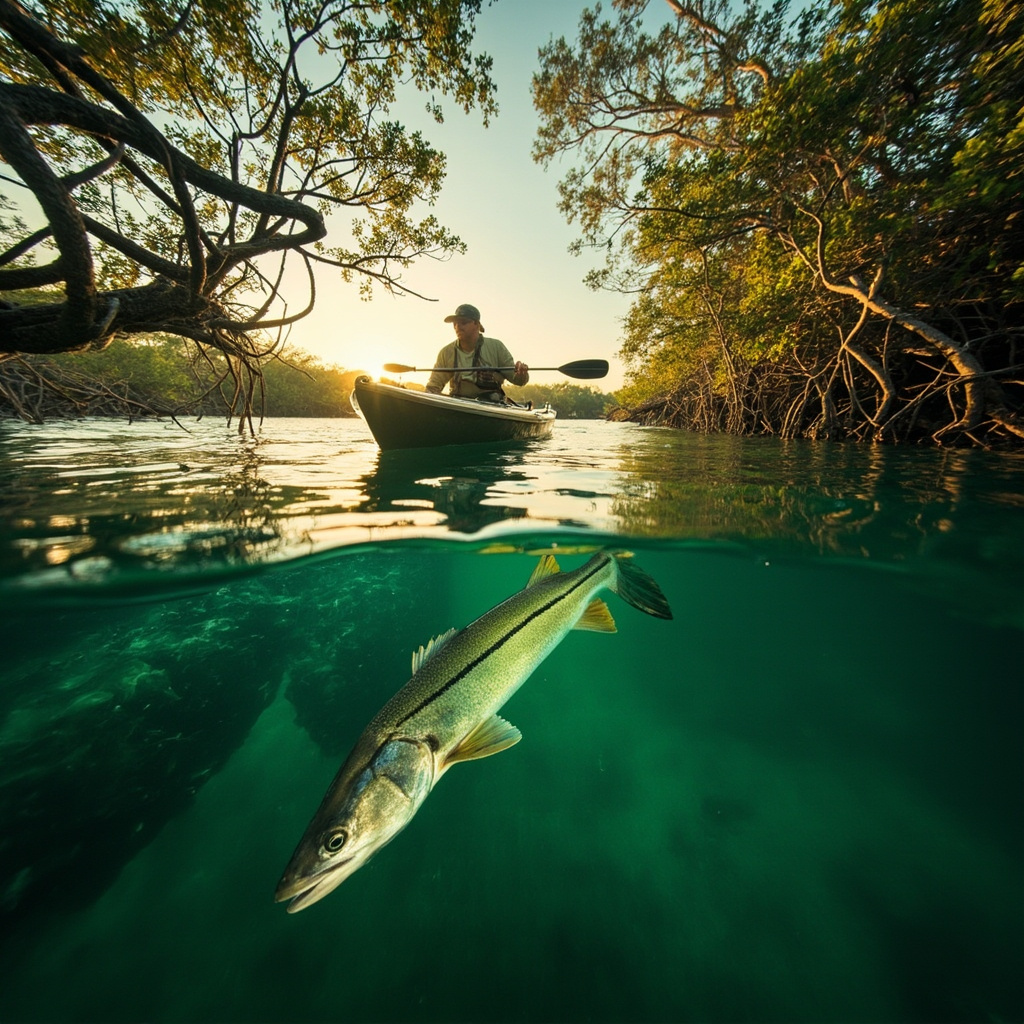
Table of contents
- Understanding the Species: The Linesider's Biology and Behavior
- The Thermal Limit: Why They Stay South
- Saltwater or Freshwater? Both.
- Habitat and Seasonal Patterns
- Spring: The Great Migration
- Summer: Beach Parties and Pass Spawning
- Fall: The Mullet Run Chaos
- Winter: The Backcountry Retreat
- Gear Recommendations for the Kayak Angler
- The Rod and Reel Setup
- Choosing Your Craft
- Lures and Baits That Actually Work
- The Artificial Arsenal
- Live Bait
- Strategic Kayak Stealth: The "Low Profile" Advantage
- Shadow Management
- Silence is Golden
- Essential Safety for Kayak Anglers
- Wear the PFD
- Be Visible
- Weather Watch
- Conservation: Don't Kill the Sport
- The Best Snook Kayak Spots
- FAQ
The snook is the holy grail for salt-of-the-earth kayak anglers in coastal U.S. waters. Think of them as a cross between a largemouth bass on steroids and a mean saltwater striped bass. The common snook (Centropomus undecimalis) isn't just a fish; it's an obsession defined by explosive strikes, gill-flaring jumps, and a nasty habit of dragging your line through every barnacle-covered root it can find. For us in a kayak, the snook is the perfect adversary -- thriving in those skinny, tangled waters where big bay boats just can't squeeze through.
Forget the generic advice you'll find at big-box stores. We're diving deep into the technical world of kayak-specific snook tactics. From timing the "snook highway" to staying safe in the heavy mangroves, here is everything you need to hook and actually land a trophy linesider from your plastic throne.
Understanding the Species: The Linesider's Biology and Behavior
To catch a snook, you have to think like one. That signature protruding lower jaw and the bold black "racing stripe" running from the gill plate to the tail aren't just for looks — they're the tools of a professional ambush predator.
The Thermal Limit: Why They Stay South
Snook are tropical to their core. They don't do cold. According to peer-reviewed research by Adams et al. published through the University of Southern Mississippi's Gulf Coast Research Laboratory, common snook suffer mortality when water temperature drops below their lower thermal limit of roughly 12.5°C (≈54.5°F) for about 10 days. A separate NOAA-funded study archived in the NOAA Institutional Repository found individual lower lethal temperatures along Florida's Gulf coast ranging from 7.9 to 10.5°C, with fish ceasing feeding near 14.4°C. For the kayak angler, the practical takeaway is unchanged: if the water drops below 54°F for more than a day or two, it's game over for them. That keeps your hunt in Florida, South Texas, and a few lucky pockets in southern Georgia.
Saltwater or Freshwater? Both.
One of the coolest things about snook is their euryhaline nature. They're just as happy in a salty ocean pass as they are in a freshwater creek miles inland. This is where the kayak is a total cheat code. We can launch in backyard ditches and drainage ponds where snook hide during cold snaps — places a flats boat wouldn't dream of going.
Habitat and Seasonal Patterns
Success here is 90% location. Since we're moving at 3 or 4 miles per hour rather than 40, you have to be surgical about where you drop that kayak in the water.
Spring: The Great Migration
When March and April roll around and the water warms up, snook start moving out of their winter backwater apartments toward the coast. They love "corridors" — think residential canals and river systems. Target bridge pilings and docks with some serious current flow.
Summer: Beach Parties and Pass Spawning
During the heat of summer, snook pile into ocean passes and along the surf to spawn. This is peak sight-fishing time. You can pedal or paddle just 20 yards off the sand and cast into the troughs where these fish cruise like ghosts in the wash.
Fall: The Mullet Run Chaos
This is the Super Bowl. As massive schools of mullet head south, snook set up ambush points. Every point of land, jetty, or mangrove corner with a bit of current becomes a buffet line. If the water is churning with bait, throw something big and hold on.
Winter: The Backcountry Retreat
When that first real cold front hits, snook retreat. They look for "dark bottom" areas — mud or leaf litter — that soak up the sun and hold heat like a radiator. Look for deep holes in the bends of tidal creeks where the water stays a few degrees warmer.
Gear Recommendations for the Kayak Angler
Deck space is at a premium. You can't bring 15 rods, so every piece of gear has to earn its keep.
The Rod and Reel Setup
A 7-foot, medium-heavy rod with a fast action is your bread and butter. You need that fast action to "skip cast" lures deep under mangrove overhangs, but you need the medium-heavy backbone to winch a fish out of the roots before he snaps you off.
Pair it with a 3000 to 4000 series spinning reel. Look for a carbon fiber drag that won't stutter; snook are famous for a 20-yard "death run" the second they feel the hook. I recommend 15lb to 20lb braided line. Braid is a must because it has zero stretch, which helps you get a solid hook set even when you're sitting low to the water.
The most important part? Your leader. Snook have gill plates like razor blades and mouths like sandpaper. Run a 25lb to 40lb fluorocarbon leader. If you're fishing heavy dock pilings or nasty mangroves, don't be shy about bumping up to 50lb.
We learned that the hard way two seasons ago on a falling tide in a residential canal, when we horsed a slot snook out of a mangrove tangle on 20lb braid with a 20lb fluoro leader. One head shake, and the gill plate did exactly what a gill plate does. We walked back to the launch with a knot in our stomachs, bumped to a 40lb leader the next morning, and our landing rate has not been the same since.
Choosing Your Craft
For snook, a pedal-drive kayak is a massive advantage. It lets you hold your position in a ripping current while both hands stay on the rod. That said, a traditional paddle kayak is much quieter in the "skinny water" where snook get spooked by the slightest vibration.
| Feature | Preferred Spec | Why It Matters for Snook |
|---|---|---|
| Kayak Length | 12' - 14' | Short enough to pivot in tight mangrove creeks, long enough to track across open flats when sight-casting passes |
| Weight Capacity | 350+ lbs | Buoyancy for a standing sight-caster plus a cooler of livies, which is the difference between casting and poling for snook |
| Material | Rotomolded Polyethylene | Bounces off oyster bars and submerged mangrove roots instead of cracking like composite layups will after one bad landing |
| Price Range | $1,200 - $3,500 | Entry paddle boats around $1,200 handle backwater creeks; pedal-drive rigs with stealth anchoring run $2,500 and up |
Lures and Baits That Actually Work
The Artificial Arsenal
- Soft Plastic Paddle Tails: A 3- to 5-inch swimbait on a weedless weighted hook is the gold standard. It looks like a finger mullet or pinfish and skips like a stone into the dark shadows.
- Topwater Plugs: If it's dawn or dusk, start "walking the dog." There is nothing in fishing more violent than a snook blowing up on a topwater lure.
- Suspended Jerkbaits: These are "finesse" killers for the edges of mangroves or bridge shadow lines.
Live Bait
If you're going the live route, shrimp or pinfish are king. You'll need a tow-behind bait bucket or an integrated livewell to keep them lively. A "free-lined" shrimp drifted naturally into a dock shadow is about as close to a guaranteed hookup as it gets.
Strategic Kayak Stealth: The "Low Profile" Advantage
One reason we often out-fish the guys in the $60,000 bay boats? Stealth. Snook are incredibly skittish.
Shadow Management
Watch your shadow. If you approach a mangrove line with the sun at your back, you're casting a 20-foot "I'm here to catch you" silhouette over the fish. Always keep the sun in your face when approaching a target.
We made that mistake exactly once, on a flat at high noon with the sun directly behind us. Every snook in the area spooked at least 30 feet before our lure ever hit the water.
Silence is Golden
Dragging a heavy metal anchor across the bottom is like ringing a dinner bell for "no thank you." Use a stake-out pole or a trolley system to pin yourself to the bottom silently.
Essential Safety for Kayak Anglers
Let's be real: kayak fishing has its risks. You're small, low, and vulnerable.
Wear the PFD
According to the U.S. Coast Guard's 2023 recreational boating statistics, where cause of death was known, 75% of fatal boating accident victims drowned, and 87% of those drowning victims were not wearing a life jacket. Get a high-back fishing PFD and wear it. Don't leave it strapped to the crate behind you.
Be Visible
Snook love the dark. If you're out at 4 AM or hanging around after sunset, both the U.S. Coast Guard Navigation Rules and the American Canoe Association's paddlesports safety guidance require an all-round white light visible for at least two miles. In a kayak, you're invisible to a guy in a center console until you're under his bow. Don't take that chance.
Weather Watch
Check the NOAA National Weather Service marine forecast before you even load the truck. A 15-knot wind might feel like a breeze on land, but it'll turn a tidal pass into a washing machine. Have a VHF radio or a waterproof phone case at the ready.
Conservation: Don't Kill the Sport
Snook are a precious resource and heavily protected. Check your local state laws for slot limits and license requirements — both Florida and Texas require a special permit or endorsement on top of a standard saltwater license. In Florida the slot is currently 28 to 33 inches total length, and in Texas the daily bag is one fish between 24 and 28 inches — confirm the current season before you go, because both states split the calendar into open and closed windows.
- Circle Hooks: If you're using bait, use circle hooks. They almost always catch the corner of the mouth rather than the gut.
- Wet Hands Only: Snook have a protective slime coat. Touching them with dry hands is like giving them an infection. Wet your hands before the "hero shot."
- Support the Weight: Don't "boga-grip" a big snook and hang it vertically. You'll tear their internal ligaments. Support the belly with one hand and the jaw with the other.
The Best Snook Kayak Spots
- The Everglades, FL: The "10,000 Islands" is the ultimate wilderness for the silver king. Mangrove tunnels for days.
- Sebastian Inlet, FL: Famous for giants, but the current is no joke. This is for experienced pedalers.
- Charlotte Harbor, FL: A massive, shallow estuary that feels like it was designed for kayaks.
- Lower Laguna Madre, TX: The best spot for snook in Texas, where you can actually target them on shallow grass flats.
Looking to rent or find a guide? Check out our regional hubs for Tampa Kayak Rentals, Miami Paddle Sports, and Sarasota Kayak Tours.
FAQ
Do I need a special license for snook? Yes. In Florida, you need a saltwater license and a snook permit, even if you're catching and releasing. In Texas, you'll need a saltwater endorsement on your fishing license to land one. Don't let a game warden catch you without one; the fines aren't worth the risk.
When is the best time to go? Snook are "low light" hunters, so dawn and dusk are prime. However, tide trumps time every single day. You want the water moving — either coming in or going out — to wash the bait toward the snook's face.
Can I use a 10-foot "sit-in" kayak? I wouldn't. Snook country usually involves current and sharp oyster bars. A 12- to 14-foot "sit-on-top" is safer, way more stable, and actually lets you stand up to spot the fish before you cast.
Why does my line keep snapping? It's likely those gill plates. They are sharper than your kitchen knives. If your leader is too thin, one head shake and it's over. Switch to a 30lb or 40lb fluoro leader and watch your landing rate skyrocket.
Mastering the kayak snook game isn't just about the catch -- it's about the stealth, the environment, and the technical challenge of fighting a powerhouse from a small plastic boat. Follow the safety advice from the ACA and USCG, respect the fish, and you'll see why people get addicted to the linesider. See you on the water.
— About the author
Mason Rivera
Kayak Fishing, Gear Reviews · Fishing Kayak Specialist · Kayak Fishing, Gear Reviews
Mason Rivera focuses on kayak fishing equipment, rigging setups, and on-the-water performance. His articles compare popular fishing kayaks, electronics, and accessories while helping anglers find gear that matches their budget and fishing style.
View full profileRecommended for you
Related reads
 guide
guideKayak Fishing for Beginners: The Real-World Guide
The no-nonsense guide to starting kayak fishing safely, from choosing the right boat to landing your first big catch.
 Species Guide
The Relentless Pursuit: Kayak Fishing for Bass Guide
The ultimate guide to chasing bass from a kayak, covering gear, stealth tactics, and safety.
 species
Kayak Fishing for Tarpon: The Angler's Guide to the Silver King
The ultimate expert guide to targeting the legendary Silver King from a kayak, covering heavy-duty gear, high-stakes tactics, and essential safety.
You may also like
View all →Related species
 species
Kayak Fishing for Tarpon: The Angler's Guide to the Silver King
Want to survive a 'Florida Sleigh Ride'? Learn how to hunt the legendary Silver King from a kayak with this guide to heavy-duty gear, high-stakes tactics, and essential safety.
 species
Kayak Fishing for Trout: Complete Guide
Master kayak fishing for trout with our comprehensive guide. Explore habitats, gear setup, safety protocols, and the best tactics for Rainbow, Brown, and Brook trout.