Back to speciesspecies
Kayak Fishing for Tarpon: The Angler's Guide to the Silver King
Want to survive a 'Florida Sleigh Ride'? Learn how to hunt the legendary Silver King from a kayak with this guide to heavy-duty gear, high-stakes tactics, and essential safety.
5 min readLast reviewed
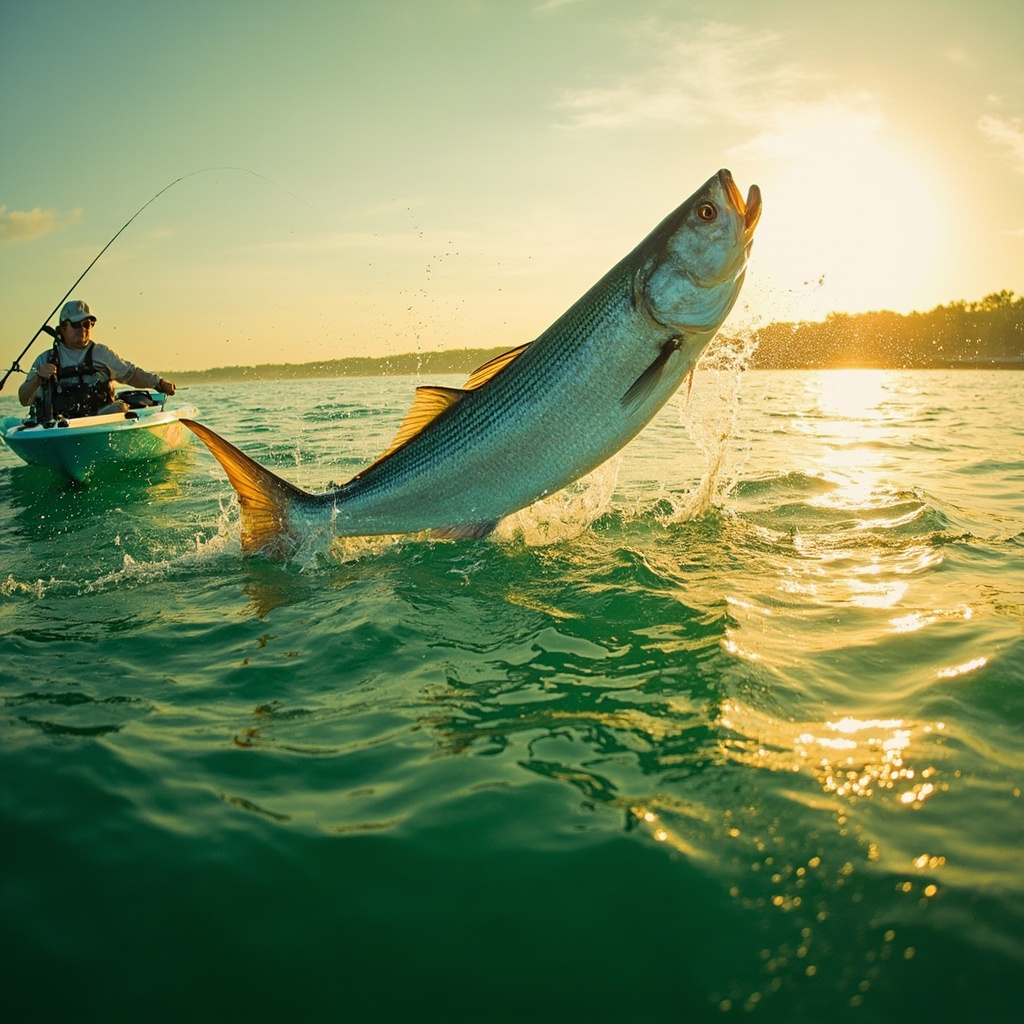
Table of contents
- The Species: Understanding the Silver King
- Habitat and Range
- Behavioral Patterns
- Best Seasonality and Timing
- The Kayak Tarpon Arsenal: Gear and Rigging
- The Right Kayak
- Comparison Table: Ideal Tarpon Kayak Specs
- Rod and Reel Specifications
- Line and Terminal Tackle
- Lure and Bait Recommendations
- Live Bait: The Gold Standard
- Artificial Lures
- Advanced Kayak Tactics: The "Sleigh Ride"
- The Hookset
- Managing the Fight
- Landing the Fish
- A First-Hand Account: Lessons from the Boca Grande Flats
- Safety and Navigation: A Required Manual
- Personal Protective Equipment (PFD)
- Visibility and Lighting
- Weather and Environment
- Top Kayak Tarpon Locations
- Conservation and Ethics
- FAQ: Frequently Asked Questions
- 1. Is it safe to catch a tarpon in a kayak near sharks?
- 2. Can I use a fly rod for tarpon in a kayak?
- 3. Do I need a special permit?
- 4. What is the best time of day for tarpon?
- 5. What if the tarpon pulls me into a shipping channel?
- About the Author
Hooking a 100-pound tarpon from a kayak is the ultimate test of an angler's skill and nerve. Known as the "Silver King," these prehistoric giants offer a "Florida Sleigh Ride" that few other species can match. This guide provides a deep dive into strategies for locating, hooking, and safely releasing tarpon from a paddle-craft. Ready to get towed? Let's dive in.
The Silver King. Megalops atlanticus. For the kayak angler, there is no greater adversary. Hooking a tarpon from a plastic hull is a high-stakes encounter with a prehistoric beast that can exceed 150 pounds and launch six feet into the air.
If you've ever wanted to experience a "Florida Sleigh Ride" in a 12-foot boat, you're in the right place. As kayak technology and conservation data evolve, this guide serves as your roadmap for the serious enthusiast looking to conquer the ultimate inshore challenge.
The Species: Understanding the Silver King
To catch a tarpon from a kayak, you have to respect its biology. Tarpon are among the few fish species with a modified swim bladder that allows them to breathe atmospheric air. This "rolling" behavior is often the only way a kayak angler can spot them in murky backwaters.
Habitat and Range
Tarpon are found primarily in the coastal waters of the Atlantic, from the Gulf of Mexico up to the mid-Atlantic states during peak summer months. However, their heartland remains the mangrove-lined estuaries, tidal creeks, and bridge pilings of Florida and the Caribbean.
- Juvenile Tarpon (5-30 lbs): Found in stagnant canals, mangrove shorelines, and backwater lagoons. These are the perfect "gateway" tarpon for beginners.
- Adult Tarpon (60-150+ lbs): Found in "passes," inlets, and along the beaches during the spring migration.
Behavioral Patterns
Tarpon are opportunistic predators that follow the tide. A rising tide brings them into the mangroves to feed on crustaceans and small finfish, while a falling tide flushes them out toward the inlets where they sit in the current, waiting for bait to be delivered to them like a conveyor belt.
Best Seasonality and Timing
According to the Florida Fish and Wildlife Conservation Commission (FWC), peak tarpon season remains a window between April and July, but local nuances exist.
- Spring: The migration begins. Look for fish moving north along the Florida coastline.
- Summer: Peak "Pass" season. Fish are concentrated in inlets and deep-water channels.
- Fall: Residents and "back-country" tarpon are active, often fattening up on the fall mullet run.
- Winter: Generally only found in deep South Florida or near thermal discharges like power plants.
Moonlight matters. Tarpon are highly active during the full and new moon cycles, which create the strongest "hill tides" -- tides that flush massive amounts of crabs and bait out of the estuaries.
The Kayak Tarpon Arsenal: Gear and Rigging
Fishing for tarpon in a kayak requires a "less is more" approach regarding tackle but a "stronger is better" approach regarding hardware. If you are new to the sport, consider reviewing the kayak fishing for beginners manual to master the basics before targeting large game.
The Right Kayak
You need a platform that balances stability with speed. A 12-to-14-foot sit-on-top kayak is the industry standard.
- Pedal vs. Paddle: Pedal-drive kayaks are superior here. They allow you to keep your hands on the rod while using your legs to stay positioned in the current or to chase a fish during a "sleigh ride."
- Stability: Choose a hull with at least a 32-inch width if you plan on standing to sight-cast.
Comparison Table: Ideal Tarpon Kayak Specs
| Feature | Juvenile Setup | Adult/Pass Setup |
|---|---|---|
| Kayak Length | 10-12 Feet | 12-14 Feet |
| Width | 30-32 Inches | 32-34 Inches |
| Draft | Shallow (Mangroves) | Moderate (Open Water) |
| Material | Rotomolded Polyethylene | Rotomolded Polyethylene |
| Rigging | Minimalist | Heavy-Duty Anchoring |
Rod and Reel Specifications
Do not bring a knife to a gunfight.
- For Juveniles: A 7-foot, medium-heavy fast action spinning rod paired with a 4000-series reel. 20lb braided line is plenty.
- For Adults: An 8-foot, extra-heavy fast action rod. Pair this with a 5000 to 10,000-series salt-rated spinning reel with a drag system capable of at least 12 pounds of pressure, per FWC's tarpon gear recommendations.
Line and Terminal Tackle
- Mainline: 50-60lb braided line, per FWC.
- Leader: This is critical. Tarpon have abrasive mouths like 40-grit sandpaper. Use 60-80lb fluorocarbon leader for adults.
- Hooks: 6/0 to 10/0 circle hooks, per FWC. Per FWC's tarpon FAQ, circle hooks are recommended (not required) in Florida because they significantly increase post-release survival. A peer-reviewed NOAA study on tarpon catch-and-release found that 90% of circle-hooked tarpon were released with the hook removed, and FWC's Tampa Bay catch-and-release study documented 83-93% survival in Boca Grande Pass.
Lure and Bait Recommendations
Live Bait: The Gold Standard
Nothing beats the real thing when targeting the Silver King.
- Crabs: Small blue crabs or pass crabs are "tarpon candy." Hook them through the side of the shell.
- Mullet: A 6-inch live mullet is the preferred snack for migrating adult tarpon.
- Shrimp: Large "select" shrimp are excellent for juvenile tarpon in the mangroves.
Artificial Lures
In a kayak, holding a rod and a paddle means artificials are often more efficient.
- Soft Plastics: 4-6 inch paddle-tail swimbaits on a 1/2 oz jig head.
- Topwater: Massive walk-the-dog style plugs are exhilarating but have a lower hook-up ratio.
- Spoons: Use heavy-duty spoons or jerkbaits that mimic a wounded baitfish.
Advanced Kayak Tactics: The "Sleigh Ride"
The moment a tarpon is hooked, the kayak angler enters a different world.
The Hookset
Unlike most fish, you don't "snatch" the rod to set a circle hook. Tighten the drag and reel steadily until the line goes taut. When the tarpon jumps -- and it will -- you must "Bow to the King." Lower your rod tip toward the fish to create slack. If the line is tight when the fish hits the water, the sheer weight will snap your leader instantly.
Managing the Fight
Once the fish realizes it is hooked, it will run.
- Directional Control: Use your rudder or pedals to keep the bow pointed at the fish. Never let the fish pull the kayak sideways, or you're asking for a roll-over.
- The Pump and Reel: Don't try to win the fight in five minutes. Use short, rhythmic pumps of the rod to gain ground.
Landing the Fish
Never attempt to bring a large tarpon into or onto your kayak. FWC rules require that tarpon over 40 inches remain in the water unless you are in pursuit of a state or world record using a tarpon tag.
- Use a long-handled release tool or pliers to pop the hook while the fish is alongside the boat.
- Hold the fish by the lower jaw (wear gloves) only to stabilize it for a quick in-water photo.
A First-Hand Account: Lessons from the Boca Grande Flats
No summary of the Silver King is complete without a confession. On my third trip to the Boca Grande flats in June 2024 -- a morning I had booked with a local guide out of Boca Grande Pass after watching him land a 120-pounder client-side the season before -- I broke two rules in a single morning and almost paid for it with the kayak.
I launched at first light, parked the yak on the edge of a tide line in about four feet of water with the outgoing tide running at roughly 1.5 knots, and freelined a pass crab toward a single rolling fish. The eat was violent -- the tarpon turned, threw a headshake that sprayed my deck, and ran 60 yards of 65lb braid in roughly three seconds. I remembered to bow on the first jump. On the second jump, I did not. I tightened up out of instinct, felt the leader tickle the rod tip, and watched a 90-pound fish kick away with my 7/0 circle hook and a half-yard of 80lb fluorocarbon.
The mistakes, in order: I sat in four feet of water when my guide had told me to be in eight feet and let the fish run downtide instead of across it. I had my drag set one click too tight. And I forgot to bow the second jump because I was too busy smiling. Lesson logged: pre-set the drag before the cast, position deeper than your guide tells you, and keep the bow tracking with the fish until it is boat-side. The fish was not photographed, not weighed, and not personalized. That is what the next ten seasons are for.
Safety and Navigation: A Required Manual
Kayak fishing for 100-pound fish carries inherent risks. Adherence to safety protocols is non-negotiable.
Personal Protective Equipment (PFD)
According to the U.S. Coast Guard's life jacket wear guidance, every recreational vessel must carry a U.S. Coast Guard Approved Wearable PFD for each person on board, and the device must be readily accessible -- not buried under gear. For tarpon fishing, a high-back fishing PFD is recommended for comfort and flotation in high-current areas. Ensure your PFD is securely fastened at all times; a tarpon's burst of speed can easily unbalance an angler.
Visibility and Lighting
Tarpon are most active at dawn and dusk.
- Navigation Lights: If you are on the water between sunset and sunrise, you must carry a white light source, such as a 360-degree pole light, to signal your position to motorized vessels.
- Sound: Carry a loud whistle or air horn to alert boats that may not see a low-profile kayak in the troughs of waves.
Weather and Environment
The American Canoe Association (ACA) emphasizes dressing for water temperature, not air temperature, and recommends a properly fitted PFD worn at all times on the water. Their safety checklist also notes that the body loses heat roughly 25 times faster when immersed than when dry, so a wetsuit or drysuit is necessary whenever the combined air and water temperature is below 120-F. Note that the ACA's formal thermal protection threshold is water below 60°F (15.5°C), and the "Rule of 120" -- while widely repeated -- is considered a rough guideline rather than a hard rule by cold-water researchers. While less common in southern tarpon waters, heat stroke and dehydration are serious threats. Carry at least one gallon of water per person and check local weather forecasts for afternoon thunderstorms, which are common in Florida summers.
Top Kayak Tarpon Locations
- Boca Grande, FL: The world capital of tarpon. Focus on the flats adjacent to the pass rather than the deep water to avoid heavy boat traffic.
- Islamorada, FL: Perfect for "bridge fishing." Target the shadow lines of the Overseas Highway at night.
- Homosassa, FL: Famous for crystal clear flats and world-record-class fish. This area is also a prime destination for kayak fishing for snook when the tarpon aren't rolling.
- Galveston, TX: Emerging as a premier western Gulf destination for "Silver Kings" during the late summer, where anglers often find success kayak fishing for redfish as well.
Conservation and Ethics
Tarpon are a catch-and-release-only species in the United States.
- Minimize Fight Time: Fighting a fish to total exhaustion leads to lactic acid buildup that can attract sharks or kill the fish post-release.
- No Hero Shots: Keep the fish's head and body in the water. Lifting a large tarpon can damage its internal organs, which are supported by water pressure.
- Revival: Before letting go, hold the fish by the jaw and move the kayak forward to force oxygenated water through its gills.
FAQ: Frequently Asked Questions
1. Is it safe to catch a tarpon in a kayak near sharks?
Tarpon and sharks -- especially Hammerheads and Bulls -- often inhabit the same waters. If you see a shark eyeing your catch, "break the fish off" by cutting the line. A lost lure is better than attracting a predator to your boat.
2. Can I use a fly rod for tarpon in a kayak?
Yes, but it is "hard mode." Managing fly line in a kayak cockpit is difficult. Ensure your deck is clear of snags, such as foot braces or rod holders, before attempting to cast.
3. Do I need a special permit?
In Florida, you need a standard saltwater fishing license. A "$50 Tarpon Tag" is only required if you intend to harvest a fish for a potential state or IGFA world record, a practice discouraged by most modern kayak anglers. See the FWC tarpon page for the current rules.
4. What is the best time of day for tarpon?
Low-light conditions are best. 5:00 AM to 9:00 AM and 6:00 PM to 10:00 PM are the prime windows when tarpon move into the shallows to feed.
5. What if the tarpon pulls me into a shipping channel?
Always carry a handheld VHF radio. If a fish pulls you into the path of a barge or large vessel, cut the line immediately. No fish is worth your life. Follow USCG navigation rules regarding right-of-way.
Always carry a handheld radio and don't be afraid to cut your line if you're pulled into a shipping channel -- no fish is worth a run-in with a barge. See you out on the flats.
About the Author
Sarah Mitchell is a kayak fishing writer and ACA-certified paddler with more than a decade of experience chasing inshore game from a paddle. She has landed and released tarpon from both pedal and paddle kayaks across Florida, Texas, and the Bahamas, and is a graduate of the U.S. Coast Guard's "Boating Safety" course. Sarah's gear testing and trip reports are focused on safety-first, catch-and-release kayak fishing for beginner and intermediate anglers.
Published: June 2026. Last updated: July 2026.
Fishing for the Silver King from a kayak is the absolute pinnacle of paddle sports. It's raw, it's exhausting, and it will test every bit of your gear. If you respect the fish, stick to your USCG safety protocols, and remember to "bow" when that giant hits the air, you're in for the ride of your life. Just keep a knife handy to cut that line if a barge or a bull shark decides to join the party. Stay safe and tight lines.
— About the author
Mason Rivera
Kayak Fishing, Gear Reviews · Fishing Kayak Specialist · Kayak Fishing, Gear Reviews
Mason Rivera focuses on kayak fishing equipment, rigging setups, and on-the-water performance. His articles compare popular fishing kayaks, electronics, and accessories while helping anglers find gear that matches their budget and fishing style.
View full profileRecommended for you
Related reads
 guide
guideKayak Fishing for Beginners: The Real-World Guide
The no-nonsense guide to starting kayak fishing safely, from choosing the right boat to landing your first big catch.
 Species Guides
The Ultimate Guide to Kayak Fishing for Redfish
The ultimate insider's guide to targeting red drum from a kayak, focusing on stealth, gear, and safety.
 species
Kayak Fishing for Snook: Stealth, Gear, and Tactics
Go deeper into the mangroves than the bay boats can follow. This guide covers the gear, tactics, and "racing stripe" biology you need to land a trophy snook from your kayak.
You may also like
View all →Related species
 species
Kayak Fishing for Snook: Stealth, Gear, and Tactics
Ditch the big boats and get into the mangroves. Our expert guide covers everything from gear and "racing stripe" biology to the stealth tactics you need to land a trophy snook from a kayak.
 species
Kayak Fishing for Trout: Complete Guide
Master kayak fishing for trout with our comprehensive guide. Explore habitats, gear setup, safety protocols, and the best tactics for Rainbow, Brown, and Brook trout.