Back to reviewsReview
Best Fish Finder for Kayak Under $500: Field-Tested Picks
We spent six months testing the top fish finders under $500 to see which ones actually survive the rigors of kayak fishing. From the clarity of the Garmin Striker to the map-heavy Lowrance Eagle, here is what belongs on your hull.
5 min readLast reviewed
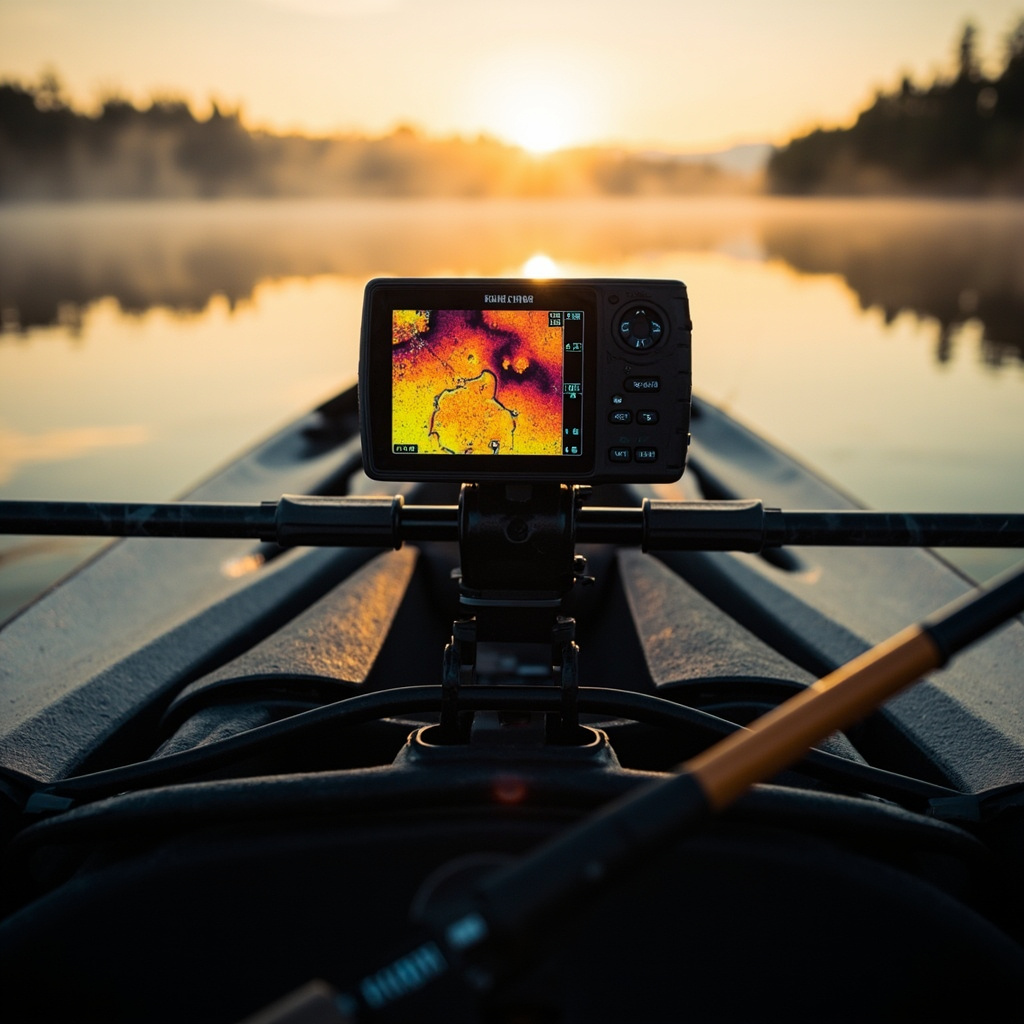
Table of contents
- Best Fish Finder for Kayak Under $500
- The Kayak Angler's Dilemma: Precision on a Budget
- Testing Methodology and Duration
- Comparison of Top Kayak Fish Finders
- 1. The All-Rounder: Garmin Striker Vivid 5cv
- Performance in the Field
- Kayak-Specific Advantages
- Cons to Consider
- 2. The Tech Powerhouse: Lowrance Eagle 5 (SplitShot HD)
- Advanced Autotuning
- The Display Advantage
- Power Management
- 3. The Minimalist Choice: Humminbird PiranhaMAX 4
- Simplicity and Size
- Durability
- 4. The "No-Drill" Alternative: Deeper Chirp+ 2
- Stealth and Weight
- Data Depth
- Kayak Safety and Navigation
- Electronics and Distraction
- PFD Usage
- Installation Nuances for Kayaks
- Transducer Mounting
- Battery Placement
- Who is Each Fish Finder For?
- Conclusion
- Frequently Asked Questions (FAQ)
- 1. Will these fish finders work in saltwater?
- 2. Can I run my fish finder and a trolling motor off the same battery?
- 3. Does a fish finder actually help you catch more fish?
- 4. How do I read a fish finder in shallow water (under 5 feet)?
- 5. Do I need a professional to install my electronics?
The gap between entry-level sonar and high-end professional units has narrowed significantly. For the kayak angler, the challenge isn't finding "enough" technology; it's finding technology that fits the unique constraints of a plastic hull. Unlike the massive battery banks of a bass boat, we require energy efficiency and durability. In this guide, we dive deep into the best fish finders for kayaks that stay under the $500 mark without sacrificing the features you actually need.
Best Fish Finder for Kayak Under $500
The Kayak Angler's Dilemma: Precision on a Budget
The gap between entry-level sonar and high-end professional units has narrowed significantly. For the kayak angler, the challenge isn't finding "enough" technology; it's finding technology that fits the unique constraints of a plastic hull. Unlike the massive battery banks of a bass boat or the dashboard real estate of a center console, we need energy efficiency, screens that don't wash out in high noon sun, and transducer mounts that won't snap off the moment you slide over a submerged stump.
When you're sitting just inches off the water, every watt-hour of battery life matters. Whether you are chasing striped bass in the Chesapeake or scanning weed edges for largemouth in a neighborhood pond, your electronics should feel like a natural extension of your boat -- not an expensive distraction. Our team spent months narrowing down the field to the best fish finders for kayaks under the $500 mark, focusing on what actually works when you're pedaling or paddling.
Testing Methodology and Duration
To give you more than just a spec-sheet comparison, our team spent six months puting these units through the wringer across three distinct environments:
- Chop and Current: Saltwater estuaries along the Atlantic coast. This was the ultimate test for corrosion resistance and mounting stability.
- Deep Raw Water: High-altitude reservoirs with depths exceeding 100 feet to see if these CHIRP signals could actually penetrate the column.
- The "Plastic Scrape": Shallow, stumpy river systems where we intentionally let transducers take a beating to test recovery time and durability.
We rigged these up on standard 10-foot to 12.5-foot sit-on-top kayaks. We tried everything from scupper-hole mounts to side-arms to check for signal interference and drag. To keep it realistic, we ran everything off a standard 10Ah Lithium Iron Phosphate (LiFePO4) battery to see which units would actually survive an 8-hour tournament day.
Comparison of Top Kayak Fish Finders
| Feature | Garmin Striker Vivid 5cv | Lowrance Eagle 5 (SplitShot) | Humminbird PiranhaMAX 4 | Deeper Chirp+ 2 (Smart Sonar) |
|---|---|---|---|---|
| Price Range | $320 - $380 | $350 - $450 | $120 - $160 | $300 - $350 |
| Display Size | 5-inch Color | 5-inch IPS | 4.3-inch Color | Smartphone/Tablet |
| Sonar Type | CHIRP + ClearVu | CHIRP + DownScan | Dual Beam | CHIRP (3 Beam) |
| GPS | High-sensitivity | Full Chartplotter | No (Depth/Temp Only) | GPS/Land-based Mapping |
| Weight | 1.1 lbs | 1.2 lbs | 0.8 lbs | 0.2 lbs |
| Key Pro | Incredible Color Palettes | Wide-Angle Sonar Cone | Simplest Interface | No mounting required |
| Key Con | No MicroSD Mapping | Highest Power Draw | No GPS Waypoints | Relies on Phone Battery |
1. The All-Rounder: Garmin Striker Vivid 5cv
The Garmin Striker series is basically the "old reliable" of the kayak world. The Vivid 5cv version takes that reputation and adds a much-needed splash of color.
Performance in the Field
The "Vivid" branding isn't just marketing fluff. These high-contrast color palettes make a massive difference when you're trying to spot fish "hugging" the bottom in murky river water. While the ClearVu (down-imaging) gives you those crisp, photographic-like views of timber and bridge pilings, we found the traditional CHIRP sonar is still the best for watching your jig drop in real-time.
Kayak-Specific Advantages
A 5-inch screen is the "Goldilocks" size for a kayak cockpit. It's big enough to run a split-screen (Sonar on top, ClearVu on bottom) without needing a magnifying glass, but it won't get in the way of your paddle stroke. Plus, the tilt/swivel mount is tough enough to survive the occasional accidental smack from a paddle blade. Garmin's published specifications list an IPX7 water rating, a 12-to-20 VDC input range, and a 1.5 A rated current for the STRIKER Vivid line.
Cons to Consider
Here is the catch: the Striker Vivid 5cv doesn't have a MicroSD card slot. You can't just plug in a pre-loaded map chip. You can use the "Quickdraw Contours" feature to map your own honey-holes as you boat, but if you want high-res maps of a new lake before you arrive, you're out of luck.
2. The Tech Powerhouse: Lowrance Eagle 5 (SplitShot HD)
If you're the type of angler who wants the best possible imaging and pre-loaded maps, the Lowrance Eagle 5 is your top contender.
Advanced Autotuning
Fiddling with sensitivity settings gets old when you should be casting. The Eagle 5 features Autotuning Sonar that does the heavy lifting for you. We moved from 5-foot shallows to 40-foot holes in a tidal zone, and the Eagle 5 adjusted its gain instantly. No manual tweaking required.
The Display Advantage
The real star here is the IPS (In-Plane Switching) display. For us kayakers who sit low and are constantly battling glare, this is a game-changer. Most LCDs "wash out" the moment you put on polarized sunglasses or look at them from an angle. The IPS screen stays crystal clear no matter how you're leaning.
Power Management
Keep in mind that all this tech is hungry. In our tests, the Eagle 5 pulled about 1.1 Amps. If you're going to run this unit, don't skimp on the battery -- get at least a 10Ah LiFePO4 so you don't go dark right when the evening bite starts.
3. The Minimalist Choice: Humminbird PiranhaMAX 4
Let's be honest: not every kayak trip requires a $400 computer. If you're mostly hitting small streams or local ponds, the PiranhaMAX 4 is the most reliable "budget" workhorse our team has tested.
Simplicity and Size
The PiranhaMAX 4 uses a vertical orientation. This is a huge win for narrow kayaks or boats with limited track space. It gives you the essentials -- depth, temperature, and fish icons -- without overcomplicating things.
Durability
The transducer is surprisingly compact. During our "Plastic Scrape" test, we dragged this thing over gravel bars more times than we'd like to admit. The mount is forgiving, and the unit picks the signal back up almost the second you hit deeper water.
4. The "No-Drill" Alternative: Deeper Chirp+ 2
For the minimalist, the inflatable kayaker, or the SUP angler, the Deeper Chirp+ 2 is a brilliant piece of kit. It's essentially a castable, grapefruit-sized orb that beams data straight to your phone.
Stealth and Weight
Since there are no wires and no heavy battery boxes, you're saving about 5 to 8 lbs of weight. On a 10-foot kayak with limited weight capacity, that's a big deal. You can tow it behind you or use a flexible arm mount.
Data Depth
Don't let the size fool you. The Deeper Chirp+ 2 offers three beam frequencies. The "Narrow Beam" (675 kHz) is fantastic for high-res scans in deep water, while the "Wide Beam" (100 kHz) helps you locate baitfish schools when you're working the shallows.
Kayak Safety and Navigation
Adding electronics to a kayak creates another demand on your attention. The USCG Navigation Rules establish how vessels should navigate to avoid collisions, while the American Canoe Association's Smart Start program covers trip planning, waterway hazards, challenging weather, and filing a float plan.
Electronics and Distraction
The biggest danger isn't the battery -- it's "eye-lock." It's easy to get so mesmerized by the sonar that you drift into a boat channel or miss a storm cloud rolling in.
- Navigation: Look up and do a 360-degree sweep every few minutes.
- Navigation Lights: Between sunset and sunrise or during restricted visibility, follow the applicable navigation-light rules. For a vessel under oars, 33 CFR 83.25 requires an all-round white light or a ready electric torch or lighted lantern showing a white light in sufficient time to prevent a collision.
- Power Reliability: GPS is great until the battery dies. Always carry a physical compass and let someone know your "float plan" before you head out.
PFD Usage
A fish finder can find the fish, but it won't keep your head above water if you flip while reaching for a snagged transducer. Wear a properly fitted USCG-approved PFD suitable for the activity. The USCG's life-jacket guidance explains that recreational vessels must have an approved wearable PFD for each person onboard and recommends wearing one whenever the vessel is underway. Fishing-specific life jackets have high-back foam that actually fits kayak seats and pockets for your whistle and signal mirror.
Installation Nuances for Kayaks
Transducer Mounting
- Scupper Mount: Very clean look, but your transducer is exposed to rocks. Stick to deep-water lakes for this one.
- In-Hull (Shoot-Through): Mounting inside the hull with epoxy. It keeps the sensor safe, but you'll lose about 5-10% of your sensitivity and won't get an accurate water temp reading.
- Side-Arm: Our team's favorite for versatility. You can swing it up when you're beaching the boat or paddling through a shallow rock garden.
Battery Placement
To keep your kayak stable, tuck the battery as low and as close to the center as possible. A waterproof battery box in the front hatch or under your seat is the way to go. Make sure you use marine-grade wiring and the fuse specified in your unit's manual. For example, Garmin's published STRIKER Vivid specifications call for a 3A, 250V fast-acting fuse.
Who is Each Fish Finder For?
- The Weekend Tournament Pro: Lowrance Eagle 5. You need those maps and the IPS screen to stay competitive when the sun is brutal.
- The Every-Species Angler: Garmin Striker Vivid 5cv. It's the perfect middle ground of clarity and price for everything from crappie to stripers.
- The Creek & Pond Explorer: Humminbird PiranhaMAX 4. Indestructible, cheap, and tells you exactly how deep that river hole is.
- The Inflatable/Travel Angler: Deeper Chirp+ 2. No drilling, no wires, and it fits in your tackle tray.
Conclusion
Finding the right sonar for your kayak is all about balancing power draw against what you actually need to see. In the sub-$500 bracket, you aren't buying "cheap" gear anymore -- you're getting professional tools in a package that fits your lifestyle. If you're looking to upgrade more than just your electronics, check out our reviews for the best pedal kayak under $2,500. Just remember: get your mounting solid, keep your battery charged, and spend as much time looking at the water as you do at the screen.
Frequently Asked Questions (FAQ)
1. Will these fish finders work in saltwater?
Absolutely. All of these are rated for salt, but saltwater is brutal. Rinse the unit and the transducer with fresh water every single time you come off the water. A little dielectric grease on the power pins will save you from a lot of headache later.
2. Can I run my fish finder and a trolling motor off the same battery?
Our team doesn't recommend it. Trolling motors create a ton of electrical "noise." If you share a battery, you'll likely see vertical lines or "snow" on your screen. Keep your electronics on a dedicated 12V LiFePO4 battery for the cleanest signal.
3. Does a fish finder actually help you catch more fish?
It doesn't guarantee a catch. It's a tool for eliminating "dead" water. Instead of casting blindly at a featureless bottom, you can find the structure, baitfish, and thermoclines where fish actually live and make a more informed decision about where to cast.
4. How do I read a fish finder in shallow water (under 5 feet)?
Sonar gets "noisy" in the shallows because of surface clutter. When you're in less than 5 feet, the signal cone is so narrow it's almost useless. In these spots, you're better off using your eyes and a good pair of polarized sunglasses.
5. Do I need a professional to install my electronics?
Not necessarily. Our team handled these installations without a professional. If you can use a drill and a wire stripper, work slowly and use plenty of marine-grade sealant on any hull holes. If you're unsure about drilling below the waterline or selecting the correct wiring and fuse, ask an experienced kayak outfitter or marine electronics installer for help.
Choosing a fish finder for your kayak comes down to how you fish and what your boat can handle. In the sub-$500 category, you're no longer settling for "cheap" gear -- you're getting professional imaging in a package that won't sink your kayak or your bank account. Get your mounting right, keep your battery charged, and try to keep your eyes on the horizon as much as the screen.
— About the author
Mason Rivera
Kayak Fishing, Gear Reviews · Fishing Kayak Specialist · Kayak Fishing, Gear Reviews
Mason Rivera focuses on kayak fishing equipment, rigging setups, and on-the-water performance. His articles compare popular fishing kayaks, electronics, and accessories while helping anglers find gear that matches their budget and fishing style.
View full profileRecommended for you
Related reads
 guide
guideKayak Fishing for Beginners: The Real-World Guide
The no-nonsense guide to starting kayak fishing safely, from choosing the right boat to landing your first big catch.
 Species Guide
The Relentless Pursuit: Kayak Fishing for Bass Guide
The ultimate guide to chasing bass from a kayak, covering gear, stealth tactics, and safety.
 Kayaking
Best Pedal Kayak for Fishing Under $2,500: Top Picks
A no-nonsense look at the best pedal fishing kayaks under $2,500. We tested drive efficiency, hull stability, and real-world durability to find the best value for your money.