Back to instructionGuides
Best Battery for Kayak Fish Finders: No-Nonsense Power Guide
Tired of your fish finder dying right when the bite turns on? We break down the math of choosing the perfect kayak battery, from lightweight lithium (LiFePO4) to budget-friendly SLA.
5 min readLast reviewed
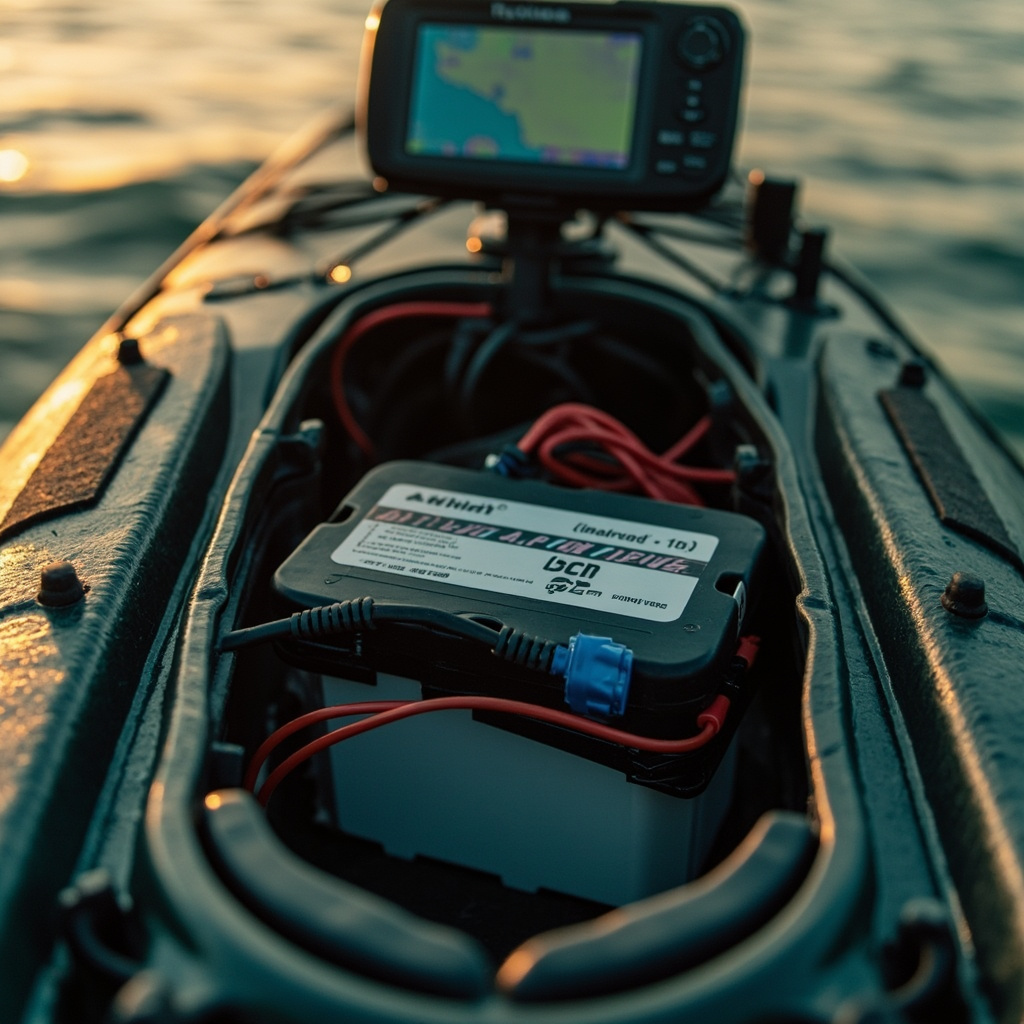
Table of contents
- Understanding Your Power Requirements: The Math
- The Amp-Hour (Ah) Calculation
- The Impact of Screen Brightness
- Battery Chemistries: SLA vs. Lithium (LiFePO4)
- Sealed Lead Acid (SLA)
- Lithium Iron Phosphate (LiFePO4)
- A Note on NMC (Nickel Manganese Cobalt)
- Comparing Battery Specifications for Kayaks
- Voltage Matters: 12V vs. 24/36V Systems
- Mounting and Waterproofing Your Power Supply
- Battery Boxes
- Connections
- Safety and Regulatory Compliance
- USCG Standards for Wiring
- Personal Flotation Devices (PFDs)
- Weather Awareness
- Navigation and Position-Finding
- Float Plan
- Weight Distribution and Stability
- On-Water Safety Disclaimer
- Charging and Maintenance
- Roundup: Choosing the Right Ah Capacity
- FAQ: Kayak Fish Finder Batteries
Rigging a kayak for electronics isn't just about sticking a transducer to the hull -- it's about how you manage your power. If you've ever had your screen go dark three miles from the launch, you know why a reliable battery matters. This guide covers everything you need to know about choosing a power source that keeps your GPS and sonar running all day without weighing your boat down.
Choosing the right battery for your kayak fish finder is one of the most critical technical decisions you'll make when rigging your boat. Gone are the days when kayak anglers had to lug around heavy, lead-acid "brick" batteries designed for home security systems. The industry has shifted toward lightweight lithium technology, and for good reason.
As power-hungry tech like Garmin LiveScope or Lowrance ActiveTarget becomes the norm, the demands on your kayak's power supply have sky-rocketed. This guide breaks down the math, chemistry, and safety protocols required to keep your sonar humming from sunrise to sunset.
About the Author. Mason Rivera is a kayak fishing specialist whose work focuses on kayak fishing equipment, rigging setups, and on-the-water performance. He compares popular fishing kayaks, electronics, and accessories while helping anglers find gear that matches their budget and fishing style. First published: June. Last updated: July.
Understanding Your Power Requirements: The Math
Before you drop money on a battery, you need to know how much juice your specific setup actually drinks. This is measured in Amps (A) or Milliamps (mA).
The Amp-Hour (Ah) Calculation
Most kayak fish finders draw between 0.5 amps and 2.5 amps per hour. To find your number, check your owner's manual for "Current Draw."
The Formula:
Current Draw (Amps) x Hours on Water = Required Amp Hours (Ah)
- Example A (Basic 5-inch screen): These entry-level units usually draw about 0.8A. If you're out for 10 hours: 0.8A x 10 hours = 8Ah. You should grab at least a 10Ah battery to give yourself a safety buffer. On my own kayak, a 9-inch Lowrance pulls close to 1.5A with side imaging running, which is why I sized up to a 20Ah pack.
- Example B (High-end 9-inch unit with side imaging): These are power hogs, often drawing 2.0A. 2.0A x 10 hours = 20Ah.
The Impact of Screen Brightness
Want to save your battery? Turn down the backlight. Running a fish finder at 100% brightness can roughly double the power draw compared to a mid-level setting. Dakota Lithium's bench testing of Lowrance HDS units found that dimming the screen significantly extended runtime -- in some configurations close to a 2x improvement. On long summer days, dropping my screen from 100% to about 60% usually buys me an extra 90 minutes of runtime -- a real lifesaver on tournament days where I'm fishing until the weigh-in. If you notice your battery dying before lunch, dimming the screen is the first thing you should try.
Battery Chemistries: SLA vs. Lithium (LiFePO4)
While there is a clear winner for most kayak fishing setups, it helps to see how the tech has evolved.
Sealed Lead Acid (SLA)
These are the old-school "black box" batteries you've seen for years.
- Pros: Dirt cheap and easy to find.
- Cons: They weigh a ton (5-8 lbs); they only last about 200-300 cycles; and you can only reliably use about 50% of the rated capacity without permanent damage. If you drain an SLA battery past the halfway mark, you're permanently damaging the cells. Battery University backs up the 200-300 cycle figure for deep-cycle lead acid, and notes that every deep cycle permanently robs the battery of a small amount of capacity. I learned this the hard way with my first kayak rig -- an SLA that was swollen and useless by the end of its second season of weekly trips.
- Verdict: Only use these if you're on a strict budget and running a tiny 4-inch monochrome screen.
Lithium Iron Phosphate (LiFePO4)
This is the gold standard for paddle sports.
- Pros: They are incredibly light (roughly 60% lighter than a comparable SLA of the same capacity). You can discharge them to nearly their full rated capacity without the irreversible cell damage SLA cells suffer at deep discharge; in practice the built-in Battery Management System (BMS) typically cuts output around 80-90% depth of discharge to protect the cells. They last for thousands of cycles -- Battery University BU-205 puts LiFePO4 cycle life at 2,000 and higher, depending on depth of discharge and temperature, and they maintain steady voltage until the very second they die.
- Cons: They cost more upfront.
- Verdict: For most kayak anglers running a 5-inch or larger screen, it is the best long-term value by a wide margin -- SLA still earns a place when budget trumps performance and you're powering a 4-inch monochrome unit. A 10Ah lithium battery weighs less than 3 pounds -- it literally fits in the palm of your hand.
A Note on NMC (Nickel Manganese Cobalt)
You'll sometimes see NMC lithium packs marketed for kayak anglers because they are roughly 20-40% more energy-dense than LiFePO4 (Advandyn). For a backcountry portage yak, that weight savings matters. The trade-off is safety: NMC cells have a lower thermal-runaway threshold than LiFePO4 and are more sensitive to overcharging, mechanical abuse, and elevated temperatures. Marine ESS guidance treats NMC as a "manageable but riskier" chemistry that needs a more advanced BMS and active cooling -- not the profile you want rattling around in an enclosed hull on a July afternoon. If you do go NMC, buy from a maker that publishes an UN38.3 test report and a marine-rated BMS spec sheet.
Comparing Battery Specifications for Kayaks
| Battery Type (Chemistry) | Avg. Weight (10Ah) | Usable Capacity | Lifespan (Cycles) | Typical Retail (10Ah) | Cell / Case Materials | Best Use Case |
|---|---|---|---|---|---|---|
| SLA (Lead Acid) | 7 - 8 lbs | ~50% (deep discharge damages cells) | 200 - 300 | $20 - $30 | Lead plates, sulfuric acid electrolyte, ABS plastic case | Budget 4" monochrome screens |
| LiFePO4 (Lithium) | 2.5 - 3 lbs | ~80-90% (BMS-limited in practice) | 2,000 - 5,000 | $60 - $100 | LiFePO4 cells, aluminum or steel case, integrated BMS | All-day tournament use |
| NMC (Lithium) | 2 - 2.5 lbs | ~80% (BMS cutoff recommended) | 1,000 - 2,000 | $40 - $70 | Nickel manganese cobalt cells, polymer wrap or steel case, marine-grade BMS required | Ultra-lightweight portage (with caution) |
Cycle-life ranges per Battery University BU-205; actual cycle counts vary with depth of discharge, load, and operating temperature. Typical retail ranges for 12V 10Ah consumer kayak-fishing batteries; actual prices vary by brand and supplier.
Voltage Matters: 12V vs. 24/36V Systems
95% of fish finders run on 12 volts, but high-end trolling motors and specialized sonar modules are pushing some anglers toward higher voltage.
- Standard Sonar: Almost all units run on a nominal 12V system. A fully charged LiFePO4 battery actually sits around 13.4V to 13.6V. Don't worry -- your electronics are designed to handle this.
- Voltage Drop: Using thin or cheap wiring over long distances causes "voltage drop." This makes your fish finder flicker or reboot whenever you hit the throttle on a motor. Stick to marine-grade tinned copper wire (14 to 18 AWG) to keep your signal clean. When I added a trolling motor to my old Jackson Coosa, my Lowrance screen started flickering every time I throttled up -- swapping the 20 AWG wire for 14 AWG marine-grade tinned copper solved it instantly. I repeated the same fix on a buddy's Hobie Compass last spring with identical results.
Mounting and Waterproofing Your Power Supply
Kayaks are wet -- period. Whether it's hull slap, rain, or paddle drip, moisture is the enemy of your electrical system.
Battery Boxes
Do not leave your battery loose in the hull. Use a gasket-sealed battery box. Many fishing kayaks now feature built-in battery pods. Just make sure the battery is secured; a heavy battery sliding around in rough surf can actually crack your hull or snap your wiring.
Connections
One of the most common reasons marine electronics fail on the water is bad connections. Ditch the alligator clips and cheap spade connectors. They'll corrode in weeks, especially in salt water. Use SAE connectors or IP67-rated waterproof screw-down plugs. A little dab of dielectric grease on the terminals goes a long way in blocking out moisture.
Safety and Regulatory Compliance
Adding power to a plastic boat isn't something to take lightly. The standards below are not optional. They're the load-bearing rules that keep a wiring mistake from becoming a lost fishing day or a worse outcome, and they're set by the U.S. Coast Guard (USCG), the American Boat & Yacht Council (ABYC), and the American Canoe Association (ACA).
USCG Standards for Wiring
The most important rule for any boat? Circuit protection. Under ABYC E-11, AC & DC Electrical Systems on Boats, every ungrounded conductor connected to a battery must be fitted with overcurrent protection within seven inches of the positive terminal. The federal manufacturing baseline for boat electrical systems sits in 33 CFR Part 183, Subpart I -- Electrical Systems, and 33 CFR § 183.420 covers batteries specifically (including the rule that metallic objects cannot contact the ungrounded terminals). That is why an inline fuse is non-negotiable on a kayak.
- Fuses: Install an inline fuse as close to the battery's positive terminal as possible. If a wire rubs against a metal gear track and shorts out, that fuse is the only thing standing between you and a fire. Most fish finders need a 3-amp or 5-amp fuse.
Personal Flotation Devices (PFDs)
A dead fish finder is the easy failure. A missing life jacket is the one that ends trips. Under 33 CFR 175.15, every recreational vessel must carry a USCG-approved wearable PFD for each person on board, and the PFD must be readily accessible. The USCG recommends (and many states require) that you actually wear it whenever the vessel is underway. Nearly 85% of people who drown while boating were not wearing a life jacket, according to the U.S. Coast Guard 2022 Recreational Boating Statistics.
Weather Awareness
Electronics can survive a squall; you might not. Before you launch, check the NOAA marine forecast for your local NWS office and pull the latest observations from the National Data Buoy Center. A NOAA Weather Radio All Hazards receiver will alert you to advisories from the water. If the forecast calls for lightning, gusts above 15 knots, or a fast-moving front, stay on the dock. The USCG Boater's Pre-Departure Checklist treats weather as a mandatory check, not a nice-to-have.
Navigation and Position-Finding
A dead fish finder should not leave you blind. The USCG Navigation Rules (33 CFR 83, the Inland Rules) apply to paddlers operating in U.S. inland waters, which means the same "look-out" and "safe speed" duties apply to a kayak as to a 40-footer. Carry a backup navigation tool -- a handheld VHF radio (Channel 16 for emergencies), a paper chart, or a GPS-equipped phone in a waterproof bag -- so you can find your way home if your primary screen goes dark.
Float Plan
File a float plan every trip. The USCG Float Plan is designed for kayakers as much as for offshore cruisers: leave a simple note with a reliable person on shore that includes your route, your departure time, and your expected return. If you don't check in, that person is the one who calls for help.
Weight Distribution and Stability
The ACA Sea Kayak Skills assessment treats "trim" -- how your boat sits in the water fore-aft and side-to-side with a loaded hull -- as a load-bearing skill. A massive 50Ah battery can seriously throw off your balance.
- Center of Gravity: Mount your battery as low and as centered as possible to keep your stability intact.
- Forward vs. Aft: If you're a big guy or gal and the stern is sitting low, try mounting the battery in the bow to level things out.
On-Water Safety Disclaimer
Kayak fishing for beginners involves real risks. Conditions change fast. Always wear a USCG-approved PFD, check the NOAA marine forecast before you leave the ramp, and file a USCG Float Plan with someone on shore. Ensure your wiring is watertight so a short circuit doesn't leave you lost without GPS in an emergency. This guide is for informational purposes -- always read your kayak's manual before you start drilling holes.
Charging and Maintenance
Lithium batteries aren't "set it and forget it." Use a dedicated lithium charger with a CC/CV profile. One major warning: never charge a lithium battery if it's below freezing. This can kill the cells permanently. If you're storing it for the winter, keep it at about 50% charge.
Roundup: Choosing the Right Ah Capacity
- 7Ah - 10Ah: The go-to for 4" to 5" screens like the Garmin Striker 4.
- 10Ah - 15Ah: The "Sweet Spot" for 7" units with GPS.
- 20Ah - 30Ah: What you need for 9" to 12" screens, or if you're running a feature-heavy unit that pulls serious current -- see the field-tested picks for budget-friendly sonar for examples of what draws this much.
- 50Ah+: Only for the "Live" transducer crowd who are drawing heavy power all day long.
FAQ: Kayak Fish Finder Batteries
Q: Can I run my fish finder and my trolling motor off the same battery? You can, but you shouldn't. Trolling motors create electrical "noise" that shows up as static on your screen. It's much better to have a dedicated small lithium battery for your electronics and a big one for the motor.
Q: Is lithium really worth the extra money? Absolutely. Swapping an 8lb lead battery for a 2.5lb lithium might not sound like much, but after eight hours of paddling, your shoulders will tell you the difference.
Q: How do I know when my battery is getting low? Set up a "Voltage Overlay" on your fish finder screen. On a 12V LiFePO4, anything in the 11.0-11.5V range is the danger zone, but the exact cutoff is set by your specific battery's BMS rather than a universal rule -- always check the spec sheet that came with your pack and confirm the manufacturer's low-voltage cut-off before relying on it as a trip-ending signal. The BMS will eventually cut power to protect the cells.
Q: Should I buy a waterproof battery or a box? Go with the box. Even if a battery is "waterproof," the metal terminals are still exposed to salt air. A sealed box is your best line of defense.
Q: Will a bigger battery make my fish finder clearer? No, but it will keep the unit from crashing or restarting when you have multiple features running at once.
Still not sure which one to get? Think about your typical day on the water. If you're a sunrise-to-sunset angler, don't skimp -- go with at least 20Ah of lithium power. You'll thank yourself when the big ones start biting at 4:00 PM and your screen is still bright.
Picking out a battery is all about balancing your power needs with the weight of your boat. By switching to lithium and following USCG wiring standards, you can stop worrying about your screen going black right when you find the honey hole. Just remember to use a fuse, grease your connections, and keep that battery secured low in the hull. Now, get out there and find some fish.
— About the author
Mason Rivera
Kayak Fishing, Gear Reviews · Fishing Kayak Specialist · Kayak Fishing, Gear Reviews
Mason Rivera focuses on kayak fishing equipment, rigging setups, and on-the-water performance. His articles compare popular fishing kayaks, electronics, and accessories while helping anglers find gear that matches their budget and fishing style.
View full profileRecommended for you
Related reads
 guide
guideKayak Fishing for Beginners: The Real-World Guide
The no-nonsense guide to starting kayak fishing safely, from choosing the right boat to landing your first big catch.
 Review
Best Fish Finder for Kayak Under $500: Field-Tested Picks
Stop guessing where the fish are. We reviewed the best kayak-friendly fish finders under $500 that actually survive the salt and stumps.
 Kayaking Guide
How to Install a Fish Finder on a Kayak: Rigging Guide
Step-by-step guide to mounting a fish finder on your kayak, covering transducers, lithium power, and waterproof wiring.