Back to guides
Kayak Paddling: Forward Stroke, Rotation, and Safety
Master efficient kayak paddling with our guide to the forward stroke, torso rotation, and USCG safety tips to reduce fatigue on the water.
5 min readLast reviewed
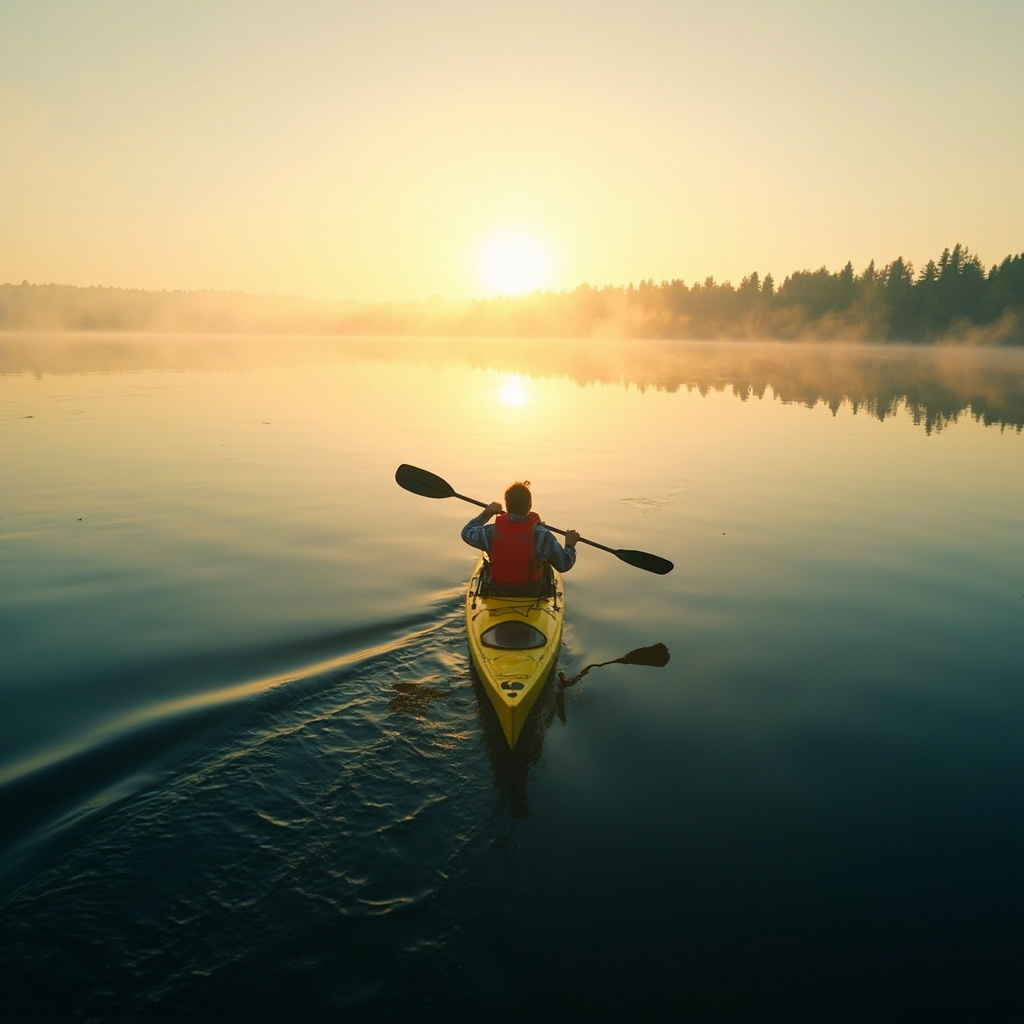
Table of contents
- Your Engine: Proper Grip and Posture
- The "Box" Position
- The Relaxed Grip
- Active Posture
- The Forward Stroke: Power Through Rotation
- 1. The Catch
- 2. The Power Phase and Torso Rotation
- 3. The Exit (The Release)
- 4. The Recovery
- Maneuvering Strokes for Control
- The Sweep Stroke
- The Draw Stroke
- Backing and Stopping
- Essential Safety and Gear Guidelines
- Safety Protocols
- Protecting Your Joints
- Frequently Asked Questions (FAQ)
- How do I know if my paddle is the right length?
- Is a high-angle or low-angle stroke better?
- Why do my hands go numb?
- How can I stay straight without a rudder?
- What safety gear is mandatory?
Whether you're sliding onto a glass-calm lake at sunrise or exploring a winding coastline, your paddle is your engine. I learned this the hard way on my first long day on Lake Sunapee -- I set out thinking my arms would carry me, and by mile four my shoulders were shot and I was still an hour from the takeout. That trip is exactly what pushed me to rebuild my forward stroke around torso rotation rather than biceps. When I retimed the same 5-mile loop a few weeks later with a rotation-first stroke, I came in noticeably faster, with tired abs instead of aching shoulders. Peer-reviewed kayak biomechanics research backs this up: Brown, Peters, and Lauder's 2023 study in the Journal of Human Kinetics found that trunk rotation and abdominal muscle activation are strongly tied to kayak velocity, with the rectus abdominus, external obliques, and rectus femoris doing the work most beginners offload onto their biceps. Most beginners make the same mistake I did, trying to muscle the blade through the water with their arms. That is the quickest way to end up sore and exhausted before lunch. To really move, you have to stop thinking of the paddle as a shovel and start seeing it as a lever. By using your whole body -- not just your arms -- you can go faster and paddle for hours without hitting a wall. The techniques below are grounded in the American Canoe Association (ACA) instruction curriculum, and I've worked through each one over hundreds of miles on flat-water lakes, tidal rivers, and coastal bays.
Your Engine: Proper Grip and Posture
Before that first blade even hits the water, your efficiency is decided by how you're sitting and how you're holding your gear. Think of it this way: poor ergonomics create "energy leaks." You're putting in the work, but it's vanishing into bad form instead of moving your boat.
The "Box" Position
Hold your paddle out in front of you. Bend your elbows at roughly 90 degrees and space your hands slightly wider than your shoulders. This is the "paddler's box." If you keep this rectangular shape between your arms and chest while you move, you'll protect your rotator cuffs and force your core to do the heavy lifting.
The Relaxed Grip
Loosen up. Beginners often fall into the "death grip" trap, which is the fastest way to get forearm cramps. Your knuckles should point toward the sky, but your fingers should wrap loosely around the shaft. If you're using a feathered paddle, let the shaft rotate slightly in your "control hand" while the other hand stays relaxed.
Active Posture
Don't get too comfortable. Slumping back against the seat deactivates your core. Sit upright or with a very slight forward lean. This "active" stance aligns your spine and gives your torso the room it needs to rotate -- which is the absolute foundation of a good stroke.
The Forward Stroke: Power Through Rotation
The forward stroke is the bread and butter of kayaking, yet it's often the most fumbled. The American Canoe Association's Smart Start for Safe Paddling curriculum breaks the stroke down into the same four phases used in every level of ACA instruction -- Catch, Power, Exit, and Recovery. If you want to move like a pro, you need to master all four.
1. The Catch
Reach forward by twisting your torso and aim for your toes. Stick the blade fully in the water before you actually pull. If you're splashing, you're wasting energy. A clean catch is silent and deep. The ACA Level 2: Essentials of Kayak Touring assessment criteria define efficient forward paddling as moving the kayak "through safe and effective body movement" with a clean catch, power, and recovery of the blade at the appropriate positions.
2. The Power Phase and Torso Rotation
Here is where most people get it wrong. How to choose a kayak paddle that matches your size is key, but stop pulling with your arms. Keep your lower arm relatively straight and rotate your whole upper body. Imagine the paddle is fixed in concrete and you are pulling the kayak past it.
Don't forget your legs! As you stroke on the right, push against the right foot brace. This creates "leg drive," transferring power from your core, through your legs, and directly into the hull. I didn't fully believe this worked until I propped my phone on the dock and filmed myself from the shore -- the instant I pushed the foot brace, the bow visibly jumped forward. The ACA River Kayak Skills Assessment explicitly notes that "torso rotation while utilizing large muscle groups improves reach and power," which is exactly the big-muscle activation we're after instead of burning out your biceps. That same big-muscle activation shows up in Brown, Peters, and Lauder's 2023 Journal of Human Kinetics study, which found that trunk rotation and abdominal muscle activation are strongly tied to kayak velocity in on-water sprint testing, with the rectus abdominus, external obliques, and rectus femoris doing the work most beginners offload onto their biceps.
3. The Exit (The Release)
Pop the blade out once it hits your hip. If you pull it further back, you're just lifting water and creating "drag." That extra movement actually sucks the back of your kayak down, making you work twice as hard to go slower.
4. The Recovery
As one side comes out, the other should be diving in. Keep your hands low -- around chest height. It keeps your shoulders from getting tired and stops the wind from catching your blade.
Maneuvering Strokes for Control
Being efficient isn't just about straight-line speed; it's about staying on course without constant, frantic corrections. The control strokes below are covered in the ACA Smart Start for Safe Paddling program as the foundation of every Level 1 kayaking course.
The Sweep Stroke
Need to turn without losing speed? The sweep stroke is your best friend. Instead of keeping the blade tight to the boat, carve a wide, circular arc from the bow all the way to the stern. Pro tip: Look where you want to go. Your body -- and the boat -- will naturally follow your eyes. The first time I really trusted a full sweep on a windy ferry crossing, I rotated my bow 90 degrees in two strokes and saved myself a 15-minute fight against the current.
The Draw Stroke
If you need to move sideways (like when you're trying to nail a perfect dock landing), use the draw stroke. Reach out to the side, plant the blade parallel to the kayak, and "pull" yourself toward it. Keep that paddle shaft vertical for the most leverage.
Backing and Stopping
Stopping fast is a safety essential. The reverse stroke is just the forward stroke in reverse gear. Look over your shoulder, plant the blade near your hip, and push forward toward the bow.
Essential Safety and Gear Guidelines
An exhausted paddler is a vulnerable paddler. Efficiency is about more than just speed; it's about making sure you have enough gas in the tank to get home safely.
Safety Protocols
- Wear the PFD: Under the U.S. Coast Guard's federal carriage requirements for recreational vessels, every boat must carry a USCG-approved wearable PFD for each person on board, and the USCG strongly recommends wearing it at all times while underway. For most recreational kayaking, a Type III PFD is the simplest legal choice -- the USCG defines Type III as suitable for conscious paddlers in calm, inland waters and for "the specialized activity that is marked on the device such as ... kayaking." A Type V PFD is only approved for the restricted uses printed on its label; many kayak-specific Type V inflatables are approved only when worn and do not satisfy the carriage requirement if they are stowed in a hatch instead of being worn. Use the USCG PFD selector to match the device to your activity before you buy.
- Check the Marine Forecast: Before you launch, pull the NOAA marine forecast for your zone -- wind speed and direction, wave height, and any Small Craft Advisories or Gale Warnings. The National Weather Service and the National Safe Boating Council recommend obtaining "the latest marine forecast and warning information" before setting out, and starting to listen for extended outlooks "several days ahead of time." A glass-calm sunrise on the dock can turn into 20-knot gusts and steep chop by the time you're mid-lake.
- File a Float Plan: Tell someone on shore where you're putting in, where you're taking out, and when you expect to be back. The ACA's Float Plan template boils it down to the "4 W's": Who is going, What you are paddling, Where you are going, and When you'll be back -- plus a check-in plan if you don't return on time. The U.S. Coast Guard Auxiliary's Paddler's Guide to Safety reinforces the same habit: a reliable contact with a clear route and return time is what turns a late paddle into a rescue instead of a search.
- Three Points of Contact: Whenever you're reaching for a snack or a camera, keep three points of your body in contact with the boat to keep your center of gravity stable.
- Dress for the Swim: The American Canoe Association -- as covered in our guide to essential kayaking safety -- reminds every paddler to dress for the water temperature, not the air. If you flip, you'll be glad you did.
- Hydrate Constantly: Fatigue often starts with thirst. A hydration bladder is great because you don't have to stop your rhythm to take a sip.
Protecting Your Joints
- Do some quick arm circles and torso twists before you launch.
- Don't "over-reach." If you're straining your shoulder to get an extra inch, you're asking for an injury.
- Make sure your paddle fits. A paddle that's too long or short will wreck your form in minutes.
- Don't ignore shoulder twinges. A peer-reviewed study of Swedish flatwater kayakers found that more than half of the paddlers surveyed reported shoulder pain, and those with pain had measurably reduced internal rotation and a high rate of scapular dyskinesis. Your shoulder is the joint you'll most often hurt, so if a tweak shows up early in the day, treat it as a signal to shorten the paddle, lighten the grip, and finish the day -- not to push through.
Frequently Asked Questions (FAQ)
How do I know if my paddle is the right length?
If it's too short, you'll keep banging the sides of the kayak. Too long, and it'll feel like you're rowing a boat. Our kayak paddle sizing guide walks through the full chart, but the short rule is this: for recreational kayaks 23-32 inches wide, Paddling Magazine's paddle buyer's guide recommends looking in the 220 cm to 240 cm range, depending on your height. Get this dialed in and half your fatigue problems disappear.
Is a high-angle or low-angle stroke better?
If you're out for a long, casual cruise, go with a low-angle stroke. It's much easier on the joints over long distances. High-angle strokes are great for sprinting or technical water, but they'll wear you out faster.
Why do my hands go numb?
Most of the time it's one of three things -- often a combination. The first is the "death grip" we talked about: a clenched top hand compresses the ulnar nerve where it runs through your palm and wrist. The second is a PFD whose armholes ride up and pinch the axillary vessels under your armpit, cutting off circulation. The third is sustained wrist extension, where you hold your wrist cocked back for hours on end; paddling coaches and sports-medicine writers have documented this pattern in flat-water kayakers as a leading cause of tingling fingers and forearm pain. The fix list is the same for all three: relax your grip and "hook" the paddle with your fingers rather than clenching it, slide your PFD armholes down a notch, and take micro-breaks to shake out your hands. If the numbness keeps coming back even after you loosen your grip and adjust your PFD, stop paddling and get it checked out -- persistent hand or finger numbness while kayaking can be a sign of ulnar-nerve compression, carpal tunnel syndrome, or Raynaud's syndrome, and is worth bringing to a healthcare professional rather than trying to paddle through it.
How can I stay straight without a rudder?
Focus on symmetry. If you're veering left, your right side is likely pushing harder. You can also try "edging" -- tilting the boat slightly with your hips -- to help the kayak track straighter.
What safety gear is mandatory?
Aside from a USCG-approved wearable PFD for each person on board, which is required under federal carriage rules, the ACA recommends a whistle, a bilge pump or a large sponge, and a spare paddle. If you're out after sunset, you absolutely need a white navigation light.
Once you stop "arm-paddling" and start using your core, everything changes. The first time I paddled the length of Lake Sunapee with this rotation-first stroke, I came off the water with tired abs and loose shoulders -- the opposite of how I'd finished the same run two summers earlier. You'll stop fighting the water and start gliding through it. These techniques, backed by the American Canoe Association and corroborated by peer-reviewed kayak biomechanics research, aren't just for pros -- they're the key to making sure your time on the water is spent enjoying the view rather than nursing sore muscles. Find your "box," trust your rotation, and see how much further you can go when you paddle smarter, not harder.
Safety Disclaimer: Kayaking carries inherent risks. Always wear a U.S. Coast Guard-approved life jacket, check the weather forecast, and tell someone where you're going. Consider taking a local skills class to master self-rescue techniques.
— About the author
Lauren Bennett
Paddling Content Editor · Outdoor Recreation Writer · Beginner Kayaking, Safety, Buying Guides
Lauren Bennett writes educational kayaking guides for beginners and recreational paddlers. She covers safety practices, kayak selection, paddling techniques, and trip planning with clear, easy-to-follow advice designed to make kayaking more accessible for everyone.
View full profileRecommended for you
Related reads
Safety Guides
Essential Kayaking Safety: What Every Paddler Needs to Know
Your no-nonsense guide to staying safe on the water, covering essential gear, weather prep, and float plans.
guide
How to Choose a Kayak Paddle: A Beginner's Guide
Stop guessing your paddle size. This expert guide explains how to choose the right kayak paddle length and style based on boat width, your height, and paddling technique.
guide
The Ultimate Kayak Paddle Sizing Guide (Chart Included) 🛶
Forget the guesswork. This guide breaks down exactly how to choose the right kayak paddle length using simple sizing charts and expert tips to prevent injury.
You may also like
View all →Related guides

guide
Kayaking in Europe: An Insider's Guide, Alps to Adriatic
Discover the best kayaking in Europe, from Alpine lakes to the Adriatic coast. Expert tips on gear, safety protocols (PFD & USCG), and top destinations for U.S. paddlers.
guide
The Best Portable Kayaks for Travelers and Urban Commuters
Skip the roof rack. This guide breaks down the best foldable and inflatable kayaks for travelers and urban commuters, featuring high-pressure drop-stitch tech and essential USCG safety tips.
guide
Best Kayaks for Kids: A Parent's Guide to Safety and Gear
Choosing the best kayaks for kids involves more than just picking a smaller boat. Our guide explores top-rated youth kayaks and essential USCG safety tips.