Back to guidesGuides
How Much Do Kayaks Weigh? A Guide to Not Breaking Your Back
Struggling to lift your boat? Our complete guide breaks down kayak weights by material and type, plus the safety tips you need to move heavy rigs solo.
5 min readLast reviewed

Table of contents
- Why Kayak Weight Matters Before You Hit the Water
- The "Hassle Factor"
- Portages and Secret Spots
- Vehicle Dynamics and Safety
- Categories of Kayak Weight: What to Expect
- 1. Inflatable Kayaks (20 - 40 lbs)
- 2. Recreational Sit-In Kayaks (35 - 55 lbs)
- 3. Touring and Sea Kayaks (45 - 80 lbs)
- 4. Fishing Kayaks (75 - 150+ lbs)
- The Materials Science of Weight
- Rotomolded Polyethylene
- Thermoformed ABS
- Composites (Fiberglass, Carbon Fiber, Kevlar)
- Example 1: A Solo Angler's Rig
- How to Manage Kayak Weight Without Breaking Your Back
- Use a Kayak Cart
- The "Slide and Pivot" Method
- Team Lifting
- Essential Safety Section
- Example 2: Plastic vs. Composite Touring Weight
- Weight Capacity vs. Kayak Weight
- Summary Table: Weight by Kayak Type
- Field Notes: What the Spec Sheet Can't Tell You
- FAQ
- Final Thought
Thinking about buying a new boat? The most important number isn't the price tag -- it's the weight. If you can't load it on your truck by yourself at 5 AM, it's going to collect dust in the garage. Let's dig into the cold, hard reality of kayak weights so you can spend more time on the water and less time at the chiropractor.
The question of kayak weight is the "hidden" hurdle of the paddling world. In the showroom or on a high-gloss website, every boat looks sleek, manageable, and ready for adventure. But the reality hits the moment you try to hoist a 95-pound fishing rig onto an SUV roof rack -- by yourself -- at 5:00 AM.
Understanding kayak weight isn't just about physical strength; it's about logistics, safety, and the long-term health of your joints. This guide breaks down the nuances across every major category, explains why "dry weight" can be misleading, and provides a framework for choosing a boat you can actually handle.
Why Kayak Weight Matters Before You Hit the Water
Most beginners focus on how a kayak performs once it's afloat. While hull design and stability are vital, the "off-water" experience usually dictates how often you'll actually get out there.
The "Hassle Factor"
Data from the Outdoor Foundation's Special Report on Paddlesports & Safety -- a joint publication of the Outdoor Industry Association and the Outdoor Foundation, summarized by SNEWS, and built on the Physical Activity Council's annual survey of roughly 20,000 respondents -- shows that U.S. paddling participation in 2018 was about 22.9 million people (7.6% of the population), down from 7.7% the year before. That same 53-page report also flags operator inexperience, inattention, and alcohol use among the most common causes of paddle accidents. The plain-language takeaway for new buyers: ease of use matters. If a kayak is too heavy to load solo, you're stuck waiting on a partner's schedule. A boat that sits in the garage because it's a pain to move is just a failed investment.
Portages and Secret Spots
Not every launch point is a paved ramp. In the U.S., many of the most pristine inland lakes and "skinny water" fishing spots require a "portage" -- carrying your craft over land. Whether it's a 50-yard hike through a wooded trail or dragging a boat over a sand dune, every pound starts to feel like ten after a few minutes.
Vehicle Dynamics and Safety
The weight of your kayak affects your vehicle's center of gravity. Overloading a roof rack can mess with your braking distances and cornering stability. Furthermore, lifting a heavy boat incorrectly is a fast track to rotator cuff and lower back injuries. The American Canoe Association's Smart Start for Safe Paddling program -- built on evidence-based educational standards recommended by the U.S. Coast Guard Auxiliary's B Directorate and aligned with NASBLA and the National On-Water Standards program, and authored by Dr. Robin Pope, Kelsey Bracewell, and Brett Mayer -- dedicates curriculum time to securing a boat to your vehicle and to safe loading mechanics, because the lift itself is the first injury risk of any paddling day.
Categories of Kayak Weight: What to Expect
Kayaks are not created equal. The material, length, and intended use create a massive variance in weight.
1. Inflatable Kayaks (20 - 40 lbs)
Modern drop-stitch technology has changed the game. Once dismissed as "pool toys," high-end inflatables now mimic the rigidity of hard shells while remaining the lightest options on the market.
- Best for: Apartment dwellers, small cars, and those who need to keep things light.
- The Trade-off: They are susceptible to "windage" -- getting blown around -- because they sit high on the water.
2. Recreational Sit-In Kayaks (35 - 55 lbs)
These are the standard 10-to-12-foot boats you see in most garages. Usually made of rotomolded polyethylene (plastic), they are durable but have a mid-range weight profile.
3. Touring and Sea Kayaks (45 - 80 lbs)
Because these boats are longer (14 to 18 feet), they naturally carry more weight. However, high-performance sea kayaks often use composite materials like fiberglass, Kevlar, or carbon fiber to keep the scales balanced despite the extra length.
4. Fishing Kayaks (75 - 150+ lbs)
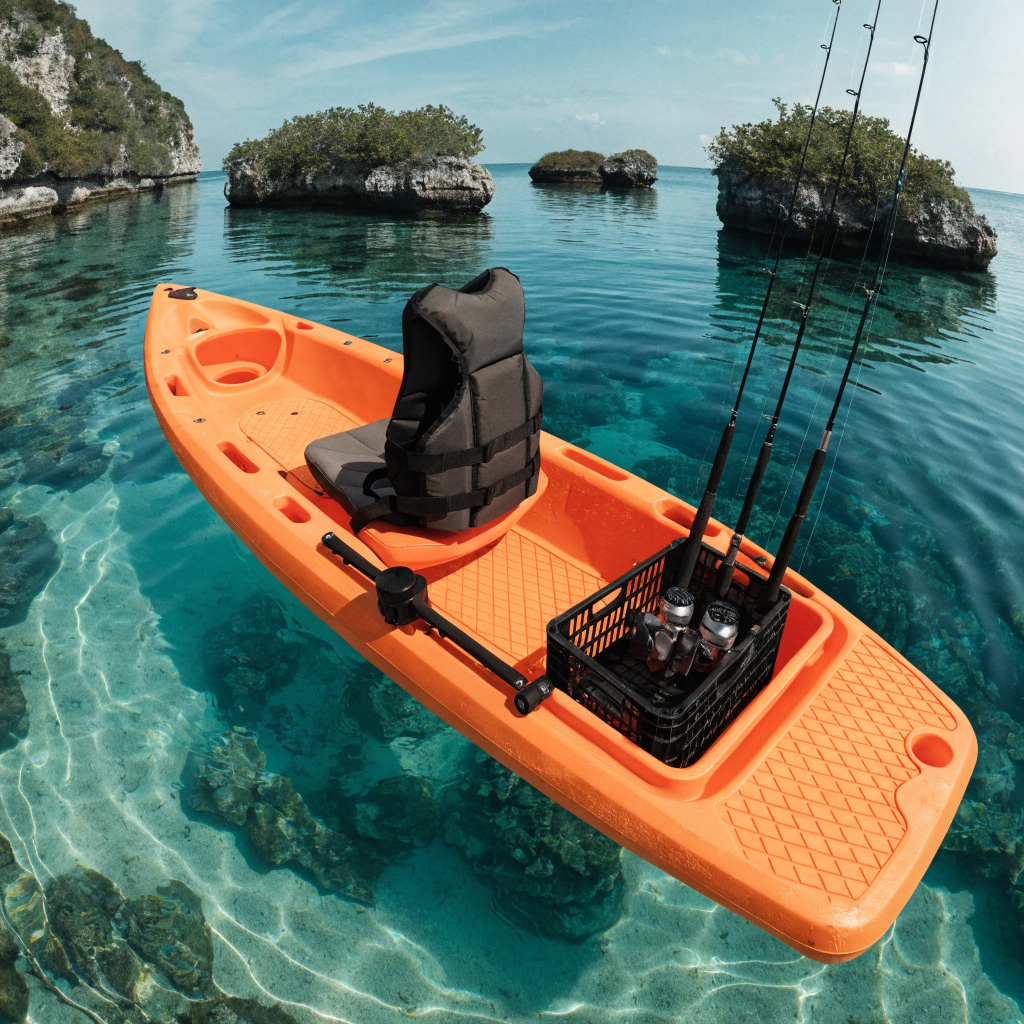
This is the heavy-hitter category. For those just getting started with kayak fishing for beginners, recent trends toward "stand-to-fish" stability have led to wider beams and beefier hulls. When you add pedal drives, electronics, and 360-degree swivel seats, these "ships" can easily blast past 120 pounds before you even toss in your tackle box.
The Materials Science of Weight
The weight of your kayak is mostly a function of what it's made of.
Rotomolded Polyethylene
This is the most common material -- essentially "baked" plastic. It is incredibly impact-resistant, making it the gold standard for rocky rivers.
- Weight Impact: Heavy. It requires a thicker hull wall to maintain its shape.
Thermoformed ABS
A middle ground between plastic and composite. It involves vacuum-forming sheets of plastic.
- Weight Impact: Roughly 15-20% lighter than rotomolded polyethylene. It also has a "glossy" finish that glides better through the water.
Composites (Fiberglass, Carbon Fiber, Kevlar)
These are handcrafted boats where layers of fabric are saturated with resin.
- Weight Impact: Feather-light. A carbon fiber touring kayak can be 30 pounds lighter than its plastic equivalent.
- Note: These are more fragile than plastic; don't go dragging them over jagged rocks.
Example 1: A Solo Angler's Rig
The numbers below are a composite scenario built from typical 13-foot pedal-drive fishing setups -- the kind of fully rigged weights that show up in owner-forum weigh-ins and bass-tournament load-out threads. They are not from a single real boat or a single real owner, and the figures are illustrative rather than measured. The point is to show how a published "hull weight" can mislead a buyer.
The Setup: A 13-foot pedal-drive fishing kayak owned by a solo angler in the Southeast U.S. The Listed Spec: The manufacturer lists the bare "hull weight" as 85 lbs. The Reality Check: When weighed fully rigged, the numbers told a different story:
- Empty Hull: 85 lbs
- Pedal Drive System: 18 lbs
- Elevated Seat: 7 lbs
- Crate & Tackle: 15 lbs
- Anchor & Battery: 12 lbs
- Total Launch Weight: 137 lbs
The Lesson: Don't get fooled by Hull Weight (the stripped boat). Always account for the Fully Rigged Weight. If you want to know how to rig your kayak for fishing properly, expect a 20-30% jump in weight once you add the gear.
How to Manage Kayak Weight Without Breaking Your Back
If you fall in love with a heavy boat, you need a strategy. Use your legs, not your back, but your best bet is to work smarter, not harder.
Use a Kayak Cart
Never "manhandle" a boat if you can roll it. A cart placed under the center of gravity allows you to move a 120-pound boat with one hand. Many modern heavy fishing kayaks now come with integrated "landing gear" or retractable wheels.
The "Slide and Pivot" Method
If you're loading a roof rack, don't try to lift the whole boat at once. Use a rear-loading roller or even a simple bath mat on the rear spoiler of your car. Lift the bow onto the back of the car, then slide the rest up. You're only ever lifting half the weight at a time.
Team Lifting
Boating-safety guidance from the U.S. Coast Guard's Boating Safety Division and the Outdoor Foundation's Paddlesports & Safety report repeatedly flag operator inexperience, inattention, and exhaustion as leading contributors to paddle-sport accidents. Don't wear yourself out before you even get on the water. If a boat requires two people, wait for a buddy or use a mechanical assist.
Essential Safety Section
Before you worry about the scales, make sure you've met the safety baseline required by the USCG and ACA.
- Life Jackets (PFD): Regardless of your kayak's weight, federal regulation (33 CFR 175.15) requires at least one USCG-approved wearable PFD on board for each person, and modern "thin-back" PFDs are designed for high-back kayak seats so you can move freely.
- Weather Awareness: Lighter kayaks are pushed around easily by "wind cocking." Always check the National Weather Service marine forecast and your local NOAA Weather Radio before you launch.
- Navigation Lights: If you're out between sunset and sunrise, the required light shapes must be visible, per the Inland Navigation Rules (33 CFR 83.20). A 360-degree white LED pole is the typical kayak-friendly solution.
- Sound Signaling: Keep a whistle attached to your PFD. Federal paddlesport rules require a sound-signaling device audible for at least half a mile -- and it's your only way to call for help if you're separated from your boat.
Example 2: Plastic vs. Composite Touring Weight
The numbers below are a composite scenario modeling two common 16-foot touring-kayak setups -- a rotomolded plastic sea kayak and a carbon fiber sea kayak -- to show how hull weight affects fatigue over time. Neither paddler is a real person, and the weights are typical published specs for boats in those classes rather than measurements from a single outfit.
The Setup: A coastal paddler in the Pacific Northwest considering two boats. The Comparison: A 16-foot Plastic Sea Kayak (65 lbs) vs. a 16-foot Carbon Fiber Sea Kayak (38 lbs).
The Result: While the plastic boat was cheaper, the heavier plastic hull produced noticeable "swing weight" -- leading to shoulder fatigue after about two hours on the water. The carbon fiber boat required significantly less energy per stroke to maintain the same pace.
The Lesson: Weight doesn't just matter at the car; it matters for every single paddle stroke. A peer-reviewed review titled "The Metabolic Demands of Kayaking" by Jacob S. Michael, Kieron B. Rooney, and Richard Smith (2008), published in the Journal of Sports Science & Medicine, explains that the energy cost of paddling increases with velocity according to a power function -- so a heavier hull demands disproportionately more effort at higher speeds. That added cost of overcoming water drag is what exercise physiologists call the kayak's "effort per mile."
Weight Capacity vs. Kayak Weight
Don't confuse the weight of the kayak with its weight capacity.
- Weight of Kayak: What the physical boat weighs on a scale.
- Weight Capacity: The total weight (You + Gear) the boat can safely carry.
A common mistake is buying a light boat with a low capacity. For best performance, follow the "60% Rule": manufacturer guidance from Eddyline Kayaks -- which advises paddlers to load boats to roughly 60-70% of the rated maximum capacity -- is echoed by other builders and by paddling instructors who teach that the captain's weight plus gear should sit well below the published ceiling for the best combination of stability and handling. If a kayak is rated for 300 lbs, that means keeping total load to about 180-210 lbs. Overloading causes the boat to sit too low, making it sluggish and prone to swamping.
Summary Table: Weight by Kayak Type
| Kayak Type | Average Weight (lbs) | Material | Primary Use | Price Range | Capacity | Length |
|---|---|---|---|---|---|---|
| Inflatable | 20 - 40 | PVC / Drop-stitch | Casual / Travel | $ - $$ | 250-400 lbs | 9-12' |
| Recreational | 35 - 55 | Polyethylene | Lakes / Slow Rivers | $ - $$ | 275-350 lbs | 10-12' |
| Day Touring | 45 - 65 | ABS / Composite | Coastal / Large Lakes | $$ - $$$ | 300-400 lbs | 12-14' |
| Fishing (Pedal) | 85 - 150+ | Heavy Polyethylene | Angling / Expeditions | $$$+ | 400-600 lbs | 12-14' |
| Sea Kayak | 50 - 80 | Fiberglass / Carbon | Open Ocean | $$$+ | 300-375 lbs | 15-18' |
Field Notes: What the Spec Sheet Can't Tell You
After enough trips to the launch ramp, a few honest lessons beat anything printed on a manufacturer's sticker:
- The lift is the worst part. The single hardest moment of owning a heavy fishing kayak is not the paddling -- it is the deadlift from the tailgate to the roof bar, alone, in the dark, with cold hands. The U.S. Coast Guard's annual Recreational Boating Statistics list operator inexperience, inattention, and exhaustion among the top contributing factors in paddle incidents, and the solo lift is exactly the moment that produces all three. The ACA's Smart Start curriculum covers "securing a boat to your vehicle" for that reason -- the trip starts in the driveway.
- Rigged weight is the only weight that matters. A 13-foot pedal boat that ships at 85 lbs routinely weighs 130 lbs or more once you add the drive, seat, crate, and battery. Plan your garage math around 20-30% more than the brochure, not 20% less, and you will never be the angler who buys a boat on Friday and posts it for sale on Sunday.
- The newest paddlers are the most at risk. USCG data, summarized by the Water Sports Foundation from the 2020 reporting year, found that 74.6% of paddling fatalities involved paddlers with fewer than 100 hours on the water, and 38.8% had fewer than 10 hours. The Outdoor Foundation's 2019 Paddlesports report puts a softer face on the same problem: about 30% of paddlers do not own a PFD, and 26% do not file a float plan. The first hundred hours of owning a heavy boat are the hundred hours you are most likely to get hurt -- which is exactly why the loading step deserves the same care as the launching step.
FAQ
Is a heavier kayak more stable? Not necessarily. Stability comes from hull width and shape, not just weight. While a heavier boat might feel "planted" in calm water, a light, wide boat can actually be much harder to flip than a heavy, narrow one.
Does the color of the kayak affect its weight? Technically, yes, but the real-world difference is negligible. Any small weight variation between two rotomolded boats of the same model comes from the thickness of the plastic pour and the masterbatch pigment loading used in production -- not from the density of the pigments themselves. The ounces saved by switching to a lighter color will not be noticeable on the water; the hull thickness and resin ratio are what actually move the needle.
How do I weigh my kayak at home? The "Subtraction Method" is the easiest. Weigh yourself on a digital scale. Then, pick up the kayak and stand on the scale again. Subtract your weight from the total. If the boat is too heavy to hold safely, place the scale under the center of the boat and use blocks to balance it.
Will my kayak get heavier over time? Actually, yes -- if it's plastic. Polyethylene is slightly porous and can absorb a tiny bit of water over the years. Even more common: deep scratches (called "fuzzing") trap water and mud. A well-used "wet" boat can easily weigh 5 pounds more than it did brand new.
Are carbon fiber kayaks worth the money? If you paddle more than 20 times a year or have any history of back or shoulder issues, absolutely. The reduction in handling weight significantly extends your "paddling lifespan" -- meaning more years on the water without injury.
Final Thought
Next time you're eyeing that flagship fishing rig with all the bells and whistles, just remember: you have to get it to the water first. If you can't lift it, you won't use it. Grab a cart, save your back, and go find some glassy water.
Next time you're eyeing that flagship fishing rig with all the bells and whistles, just remember: you have to get it to the water first. If you can't lift it, you won't use it. Grab a cart, save your back, and go find some glassy water.
— About the author
Lauren Bennett
Paddling Content Editor · Outdoor Recreation Writer · Beginner Kayaking, Safety, Buying Guides
Lauren Bennett writes educational kayaking guides for beginners and recreational paddlers. She covers safety practices, kayak selection, paddling techniques, and trip planning with clear, easy-to-follow advice designed to make kayaking more accessible for everyone.
View full profileRecommended for you
Related reads

guide
Kayak Fishing for Beginners: The Real-World Guide
The no-nonsense guide to starting kayak fishing safely, from choosing the right boat to landing your first big catch.
guide
How to Rig Your Kayak for Fishing: A Beginner's Guide
Stop fighting your gear and start catching fish. Here is exactly how to rig your kayak for maximum efficiency and safety without overcomplicating things.

guide
How to Choose a Kayak Paddle: A Beginner's Guide
Stop guessing your paddle size. This expert guide explains how to choose the right kayak paddle length and style based on boat width, your height, and paddling technique.