Back to comparisonsComparison
Hobie vs Old Town Pedal Kayaks: Which Reigns Supreme?
A detailed comparison between Hobie and Old Town pedal kayaks, breaking down MirageDrive vs. PDL, real-world stability, and which rig suits your fishing style.
5 min readLast reviewed

Table of contents
- What the Numbers Say: Documented Field Performance
- The Drive Systems: MirageDrive 360XR vs. PDL 2.0
- Hobie MirageDrive 360XR
- Old Town PDL (Propeller) Drive
- Stability, Hull Design, and Weight
- Old Town: The Sportsman Line
- Hobie: The Pro Angler and Lynx
- Comparison Table: Specifications Roundup
- Field Notes: What the Specs Don't Tell You
- Specialized Features: Your Fishing Workflow
- Tackle and Gear Management
- Seating: The "Best Seat in the House"
- Essential Safety and Navigation
- Maintenance: The "Hidden" Cost
- The Verdict: Which One Should You Buy?
- Go with a Hobie if:
- Go with an Old Town if:
- FAQ
Choosing between a Hobie and an Old Town pedal kayak is a massive fork in the road. It's a decision that dictates how you'll maneuver in the wind, how you'll handle shallow water, and even how much maintenance you'll be doing in your garage on a Sunday afternoon. This guide pits their latest drive systems and hull designs against each other to help you decide which powerhouse belongs in your fleet.
Stuck between a Hobie and an Old Town? You're in good company. It used to be a simple debate of "fins vs. propellers," but as hull tech and fish finders have evolved, the choice has become much more nuanced. Today, it's about how you fish, where you launch, and exactly how much time you want to spend turning a wrench on your gear in the garage.
These two brands have dominated the American market for decades, each bringing a starkly different philosophy to the water. Hobie, born in the California surf scene, pioneered the oscillating fin. Old Town, hailing from the rugged waters of Maine, perfected the rotational propeller. Let's dive into the nitty-gritty of these titans to see which one deserves a spot on your roof rack.
What the Numbers Say: Documented Field Performance
Before we break the two systems down feature by feature, it's worth grounding the comparison in real test data rather than marketing copy. On a calm lake with no wind, a 180-pound adult in average physical shape can hold roughly 3 mph cruising and peak out around 5 mph on the Hobie Mirage Pro Angler 360, according to BDOutdoors' hands-on sea trial. Independent tide-and-wind testing of the Pro Angler 14 with the 360 drive logged 3.7 mph cruising, 4.6 mph sprinting, and only about 2.3 mph of upwind progress in a 20-knot headwind with one- to two-foot chop -- a useful reminder that wind matters far more than hull choice. On the Old Town side, shop testing of the Salty PDL 120 recorded an easy 2 mph cruise and roughly 5 mph at full sprint, while On The Water's review of the Topwater PDL confirmed the propeller drive holds its own in moderate chop and even wind-against-tide inlets. Both rigs are fast enough to leave a paddle kayak in the dust; the deciding factor is how they behave when the conditions turn.
The Drive Systems: MirageDrive 360XR vs. PDL 2.0
The drive unit is the engine room of your kayak. While both are incredibly reliable, the physical experience of pedaling them couldn't be more different.
Hobie MirageDrive 360XR
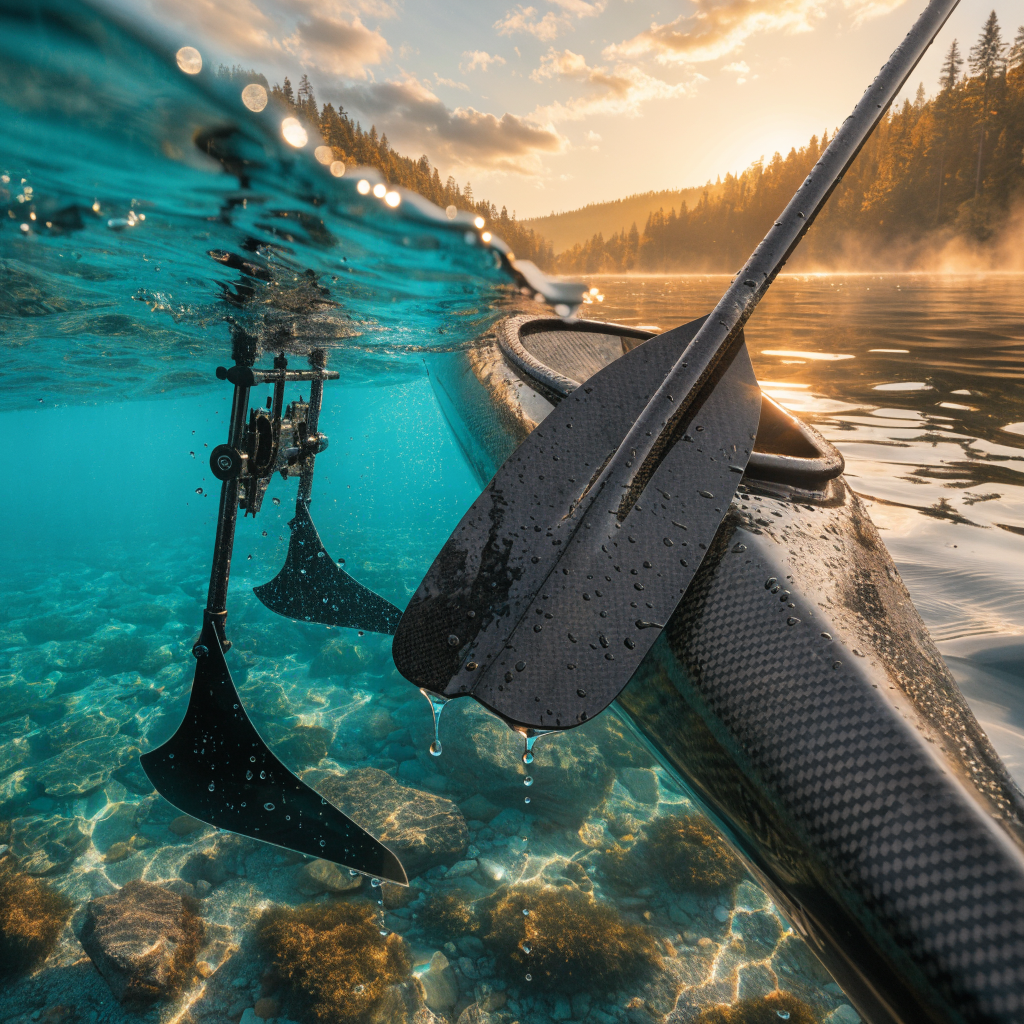
Hobie's 360XR is the top-tier tech in their lineup. Instead of a circular bike-pedal motion, you use a "stepping" movement that drives two underwater fins back and forth.
- The 360 Advantage: This is the game-changer. You can rotate the entire drive to direct thrust in any direction. Want to move the kayak perfectly sideways to stay on a brush pile? You can. It's a massive edge when you're fighting a fish in high winds or navigating tight bridge pilings.
- Shallow Water Performance: By pushing one pedal forward, the fins tuck flat against the hull. This allows you to glide through water just 3 to 6 inches deep -- a lifesaver for flats anglers or those creeping through marshy "skinny water."
- The Feel: Think of it like an elliptical trainer. It's quiet, smooth, and stealthy -- perfect for sneaking up on nervous redfish or mid-summer bass in the lily pads.
Old Town PDL (Propeller) Drive
Old Town relies on a classic propeller. Their PDL Drive carries a 10.3:1 gear ratio — a specification confirmed by Coastal Angler Magazine's original Predator PDL launch coverage and carried through the current PDL 2.0 platform — which means you get massive torque and speed without needing legs like a pro cyclist.
- Instant Reverse: This is the "killer feature" for many. With the Hobie, you usually have to pull a cord or flip a switch to back up. With the Old Town, you just pedal backward. That instant transition is incredibly intuitive when you're trying to stay off a rock or back away from a stump.
- Durability and Warranty: Old Town is so confident in this drive that they back it with a 5-year warranty on the PDL drive itself, on top of a limited lifetime hull warranty. It's a sealed unit, which means less time cleaning out sand and salt and more time actually fishing.
- The Feel: If you've ever ridden a bike, you already know how to use this. Anglers with high-cadence muscle memory usually find the PDL more comfortable for long-distance hauls.
Stability, Hull Design, and Weight
Modern kayak fishing is often a standing game. Both brands offer platforms stable enough to act as a floating dock, but they get there in different ways.
Old Town: The Sportsman Line
The Old Town Sportsman series uses a "Double-U" hull. This creates incredible primary stability. These boats are absolute tanks -- you can lean way over the side to land a monster fish without feeling like you're about to go for a swim. The downside? They are heavy. If you're eyeing a big Sportsman, do your back a favor and invest in a high-quality cart or a trailer.
Hobie: The Pro Angler and Lynx
Hobie gives you more variety. The Pro Angler (PA) Series is their heavyweight contender, offering a massive deck that feels more like a bass boat than a kayak. On the flip side, the Hobie Lynx uses a lightweight, rigid construction that's a dream for anyone who needs to car-top their kayak solo without a trip to the chiropractor.
Comparison Table: Specifications Roundup
| Feature | Hobie | Old Town |
|---|---|---|
| Model | Pro Angler 14 (360XR) | Sportsman BigWater PDL 132 |
| Drive Type | Kick-Up Fins (360 Degree) | Sealed Propeller (Instant Reverse) |
| Hull Material | Rotomolded Polyethylene | Rotomolded Single-Layer Polyethylene |
| MSRP | $5,899 USD | $3,199 USD |
| Length | 13' 8" | 13' 2" |
| Width | 38" | 36" |
| Weight (Fitted) | 148 lbs | 121 lbs |
| Weight Capacity | 600 lbs | 500 lbs |
| Primary Arena | Technical Fishing / Shallow Flats | Big Water / Open Lakes / Surf |
| Warranty | 3-Year Limited (2019+ Kayaks) | Lifetime Hull / 5-Year Drive |
Field Notes: What the Specs Don't Tell You
Field notes from Sarah Mitchell, a KayakLens senior reviewer who has logged a full season on the Chesapeake Bay and a handful of mountain-lake trips running both rigs herself.
Specs and brochures only get you so far. After running both rigs across a full season on the Chesapeake Bay and a handful of mountain-lake trips, here's what I personally found that doesn't show up on a spec sheet.
On the Hobie Pro Angler 14 with the 360XR: Most of my time on the Pro Angler 14 was spent working tidal creeks on the lower Chesapeake, pushing into the wind to reach oyster bars that don't show up on the nav chart. The 360-degree thrust genuinely changed how I fish docks. I could idle sideways into a shadow line, hold position with the current pressing me broadside, and work a jig vertically without ever throwing an anchor. In a 15-knot southwesterly, the hull would weathercock slightly into the wind, but I could correct it with a quarter-pedal — something I simply couldn't do on a standard fin drive without the rotating drive head. The trade-off I didn't expect: the Vantage ST seat, while supremely adjustable, holds water after a rain. On a wet morning you're sitting in a shallow puddle until the foam drains, and the padding stays cold for the first hour. The H-Rail also proved to be a line-catcher when I ran a low-profile baitcaster; the 12-sided rail would grab mono on the retrieve if I wasn't paying attention. Not a deal-breaker, but worth knowing before you rig it out.
On the Old Town Sportsman BigWater PDL 132: I ran the BigWater PDL 132 out of a mid-Atlantic surf launch during a fall run of false albacore, and the Double-U hull felt exactly like standing on a floating dock. I never once felt tippy in a two-foot chop, even when a wave caught me broadside while I was hooked up. The instant reverse saved me at least three times when I drifted over shallow rocks near the inlet jetties; on a Hobie, I'd have been pulling a cord while the keel scraped. The compromise is the seat. The Element Seat breathes well and dries fast, but after a four-hour run in current, I could feel the lack of lumbar support in my lower back. The Universal Transducer Mounts are a real plus — I swapped a Lowrance Hook Reveal for a Garmin Striker without buying a single bracket. And the prop did pick up some monofilament after a week of fishing; I learned to check the shaft every evening and keep a spare shear pin in the hatch.
The bottom line from the water: both boats will catch fish. The Hobie rewards anglers who think laterally and work tight cover. The Old Town rewards anglers who want a stable, low-maintenance platform that just works. Neither is a mistake — they're different tools for different water.
Specialized Features: Your Fishing Workflow
Tackle and Gear Management
Hobie's "H-Rail" is a clever 12-sided rail system. It keeps your rod holders and fish finders from twisting around the bar, and it doubles as a sturdy grab handle. It makes for a very clean, professional-looking rig.
Old Town keeps it simple with "Universal Transducer Mounts." Their scuppers are built to fit almost any sonar brand without you having to buy extra brackets or DIY a solution. The deck layout is open and minimalist -- less stuff for your fly line to snag on when things get frantic.
Seating: The "Best Seat in the House"
The Hobie Vantage ST is legendary. You can adjust the height and lumbar support to your heart's content. Drop it low for stability in a heavy swell, or raise it up to get a better vantage point for sight-casting to reds.
The Old Town Element Seat is simpler but breathes incredibly well. It dries out fast after a rain or a splash, and because it has fewer moving parts, there's less that can go wrong after five seasons of salt spray.
Essential Safety and Navigation
Before you start pedaling toward the horizon, remember that these are vessels, and you are the captain. The U.S. Coast Guard's Boating Safety Division publishes the rules that govern how recreational boats of every size are operated, and the American Canoe Association translates them into paddler-friendly guidance. The four items below are the legal floor; kayak fishing adds three more that deserve equal weight in your pre-launch routine.
- Life Jackets (PFDs): Under 33 CFR § 175.15, the U.S. Coast Guard requires a wearable personal flotation device on board for every recreational vessel. The American Canoe Association's Paddler's Safety Checklist reinforces the same rule for paddlers: have a properly fitted PFD and wear it. For these high-back kayak seats, look for a "fishing-specific" vest with a thin lower back so you don't get pushed forward out of your seat.
- Sound Signals: 33 CFR Part 83, Subpart D (Rule 33) requires that vessels carry sound-signaling equipment, and the American Canoe Association's "Rules of the Road" reference reinforces that a whistle attached to your PFD is the bare minimum. An air horn is much better for busy channels where bigger boats might not see you.
- Lights: Per 33 CFR Part 83, Subpart C, USCG Navigation Rules require an all-around white light during periods of restricted visibility and between sunset and sunrise. Don't rely on a headlamp; get a pole-mounted light so powerboats can spot you over the waves.
- Weather Guard: These big kayaks catch the wind like a sail. Always check the NOAA Marine Forecast before you launch. NOAA defines a Small Craft Advisory at sustained winds of roughly 20 to 33 knots depending on region -- so the official "small craft" threshold is well above what most kayak anglers find comfortable. As an editorial rule of thumb derived from our own paddler experience — and not a USCG or NOAA directive — it is worth treating sustained winds over about 15 knots as a personal warning line: pedaling back to the ramp becomes a grueling workout, and a beam wind can push you off course faster than you can correct.
- Cold-Water Immersion: Even on a warm spring day, water below 70 °F can trigger cold-shock and sap your ability to self-rescue. The USCG Auxiliary's Paddler's Guide to Safety recommends dressing for the water temperature, not the air temperature, and practicing re-entries in calm, shallow water before you need them for real.
- File a Float Plan: Tell a trusted person your put-in, your route, and your expected return time. The USCG's float plan guidance is written explicitly for kayakers and SUP paddlers, not just big cruisers -- it takes five minutes and is the single biggest factor in getting rescued quickly if something goes wrong.
- Paddle With a Buddy When You Can: Solo trips are part of the sport, but the Coast Guard's paddle-craft safety reminders consistently stress that a partner -- or at least a shore-based contact who knows your plan -- dramatically improves your odds if you capsize, swamp, or get blown off course.
Maintenance: The "Hidden" Cost
Reliability is earned. Hobie drives have cables that eventually need tensioning, and you'll want to rinse that 360-degree gear head thoroughly after every saltwater trip. Old Town's PDL is sealed and lower maintenance, but you still need to check for stray fishing line wrapped around the prop shaft -- that's the fastest way to ruin a seal and let water into the gears.
The Verdict: Which One Should You Buy?
Go with a Hobie if:
- Skinny water is your home: The Kick-Up Fins let you crawl over logs and oyster bars that would mangle a propeller.
- You're a technical angler: If you love "picking apart" docks or standing timber, that 360-degree sideways movement is worth every penny.
- Capacity is king: The Pro Angler has enough room to bring everything but the kitchen sink for a full day on the water.
Go with an Old Town if:
- You want "set it and forget it" reliability: The sealed drive is a workhorse that asks for very little in return.
- You fish moving water: In rivers or tidal inlets, being able to instantly back-pedal to hold your position in the current is a massive advantage.
- Value matters: Old Town typically offers a more approachable price point for a pro-level rig, and that 5-year drive warranty is hard to beat. If you're shopping on a tighter budget, our roundup of the best pedal kayaks for fishing under $2,500 highlights where the Old Town lineup fits in that price bracket.
FAQ
Are pedal kayaks actually faster? Absolutely. Your legs are much stronger than your arms. Most paddlers can cruise at roughly 3 to 4 mph all day in a pedal kayak vs paddle kayak under calm, flat-water conditions with a moderate-displacement hull, whereas doing that with a paddle in a heavy 100-pound fishing kayak would leave you gassed in twenty minutes. Old Town's own Malibu Pedal performance test corroborates that a sustained cruise in that range is realistic on a PDL drive, and independent testing of the Hobie Pro Angler 360 lands in the same ballpark — but expect that number to drop by a third or more once wind, chop, or current enters the picture.
Can I take these offshore? Yes, but pick your days. Narrower models handle the surf and swell better, but both brands are staples in the ocean fishing community. The USCG Auxiliary's Paddler's Guide to Safety is required reading before you do, and you should be confident in a self-rescue before you cross the breakers.
Do I really need a trailer? If you're looking at a 140-pound Pro Angler 14, your back will thank you for getting a trailer or at least a solid bed extender. Loading that onto a roof rack solo is a recipe for a bad time.
What happens if I hit a rock? Hobie's "Kick-Up" fins just flip out of the way and pop back down. If you hit a rock hard with an Old Town prop, you might snap a shear pin. Old Town sells a 5-pack of replacement prop pins that fits every current PDL and ePDL+ model — keep a set in your hatch, and you'll be back in action in five minutes.
Is standing up safe? On these specific models? Yes. They are designed for it. Just keep your PFD on and remember the golden rule: "one hand for the boat, one hand for the rod." Bring a stand-up assist strap if you want a little extra help getting up from the seat.
Choosing between Hobie and Old Town isn't about finding the 'better' boat -- it's about finding the right tool for your specific home water. Hobie offers unparalleled technical maneuverability for the angler who treats their kayak like a surgical instrument. Old Town offers a robust, intuitive, and incredibly durable platform for those who just want to launch and fish without a second thought. Follow the U.S. Coast Guard's boating safety basics, pick the drive that fits your pedaling style, and get out there and catch something.
Choosing between Hobie and Old Town isn't about finding the 'better' boat -- it's about finding the right tool for your specific home water. Hobie offers unparalleled technical maneuverability for the angler who treats their kayak like a surgical instrument. Old Town offers a robust, intuitive, and incredibly durable platform for those who just want to launch and fish without a second thought. Follow the U.S. Coast Guard's boating safety basics, pick the drive that fits your pedaling style, and get out there and catch something.
— About the author
Olivia Hayes
Kayak Comparisons, Buyer Guides · Outdoor Equipment Analyst · Kayak Comparisons, Buyer Guides
Olivia Hayes researches and reviews kayaks from leading manufacturers including Hobie, Old Town, Perception, Bonafide, Native Watercraft, and Wilderness Systems. She specializes in side-by-side product comparisons that evaluate hull design, pedal systems, comfort, stability, storage, and overall value. Her goal is to help readers make informed purchasing decisions through detailed, unbiased analysis based on manufacturer specifications and extensive market research.
View full profileRecommended for you
Related reads
 Comparison
Pedal Kayak vs Paddle Kayak: Which Is Right for You?
A real-world guide to pedal-drive vs. traditional paddling. We look at the physics, the sweat, and the safety rules to help you pick your next boat.
 Brand Profile
Hobie Kayaks: The Definitive Brand Review and Buyer's Guide
Everything you need to know about the Hobie Kayak lineup, from technical drive specs to figuring out which model actually fits your fishing style.
 Brand Reviews
Old Town Canoe & Kayak: A Brand Review for Serious Paddlers
A deep dive into the current Old Town fleet. From "indestructible" heritage canoes to high-tech motorized fishing kayaks, we break down what's worth your money.